There’s no motivation like the motivating kick in the butt you get when a streaming site motivates you to watch movies that are about to expire to get you motivated to watch a movie with intentional motivations.
Among the imminently expiring films were goldies like Tootsie, and The Green Mile. I elected to watch all three versions of Carrie like the fine art and film connoisseur that I am.
I did some research. There’s the original, 1976 version, then a straight-to-TV version in 2002, and then finally a 2013 remake starring Chloe Grace Moretz. I’ve known about the existence of Carrie for a while, and I always assumed it was a horror- what, with the blood and stuff? Through peripheral research I’d known it was a movie about a young woman coming of age, and then later about menstrual cycles. All the release images are of the titular character covered in blood, so I was certain that the climax involved blood, because, of course, horror.
While figuring out which movie came first, I also learned that the first one was largely regarded as the best one. Did that influence my review? Bias? Journalistic integrity? Huh?
In other words, in 1976, they made a movie. Then, they made it again, but not as good. Then, they tried a third time- and it still wasn’t as good as the first time. Talk about a fruitless waste of resources.
It’s also based on a book by Stephen King. I’m going to ignore the book for much of this review. I don’t read. I can’t remember the last time I read. I haven’t finished a book in years. This is a movie review blog. Shut up, nerd.
As an aside, why does everyone assume blood is scary? We all know it’s fake. We know that the characters aren’t actually getting hurt or being maimed, and that it’s just a movie with makeup and effects. So why give the object of blood such importance? I think that this thought is why I never really cared much for watching any of these movies. “Oh, the big scary blood girl is gonna get ya!”. Fuck you. Also, this is foreshadowing.
Anyways, that brings us back to the expiration of the films from Tubi. Ever since Netflix’s price hikes, Amazon being owned by Bezos, and AppleTV having absolutely nothing at all on its service, Tubi has been my go-to. So I scrambled. I couldn’t miss such a large swatch of movies from the only streaming site I’m on these days. So I binged the Carrie films, and figured a 3-part review was warranted. You’re welcome, kids.
The Era of Tiddies in Movies
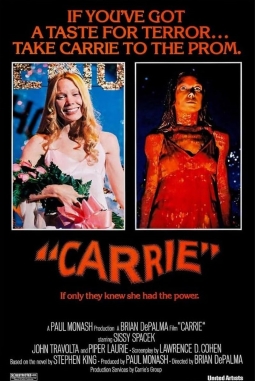
So I started the 1976 version of Carrie, and it opened with a sequence that appeals best to a guy like me. I got a slow-motion montage of a bunch of girls naked and showering in slow motion. Then, Carrie started bleeding between her legs.
I love this sequence- but not for the typical ‘hee hee hoo hoo lookit Megan Fox boobies!’ reasons- but because the film drew us in with the ‘hee hee hoo hoo lookit Megan Fox boobies!’ emotion, then slammed us with the grim, terrifying reality of what a woman’s life is like. It turned the Male Gaze on its head by swallowing us into the indulgence, then knocked us over the head with the absolute stupidity of the gaze. Fantastic work.
Then, we get the brilliance of yesteryear cinema shining through the obstacles of a lack of computer-aided effects, decades of established film language, and the ingenuity of the most basic of filmmaking effects.
Carrie’s powers are indicated through a simple, stark sound effect. Her isolation and social exclusion are developed through a series of straightforward events that take strides towards defining each character, their motivations, and their beliefs. From the onset, without droning exposition, we’re shown what each character feels, what each character wants, what each character strives for.
The teacher lady feels sympathy, and demonstrates an implied familiarity with Carrie. The blonde girl (Chris) feels insulted that her bullying was punished, and uses the people around her. The brunette (Sue) wants to fit in, but realizes the cost, and is willing to sacrifice to make amends. Carrie struggles to find a foothold in her body and society. All this within 30 minutes, all this while progressing the plot, all this in 1976, all this accomplished where Marvel’s $300 million couldn’t in any of their fuckass movies in 2025.
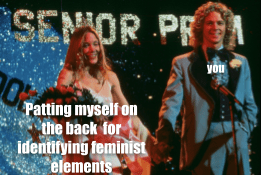
The simplicity does wonders towards communicating ideas, as the camera does the actual legwork over and over- culminating in a scene towards the climax where Carrie and her date admit that things are going well, and he validates that- despite being a star athlete he still is having a good time with her- and the camera spins around them, faster and faster as the emotional tension rises, and then peaks in its rotation as they accept their emotions and embrace. It’s a sequence so basic, yet so effective, and I couldn’t help but smile as I realized just what such a simple set of movements by the camera had accomplished.
The incredible camerawork continues with a fantastic dolly shot that foreshadows the climax, but that’s nothing compared to the best use of slow motion I’ve seen in a long while. As Carrie climbs the steps to accept her prom queen prize, the music swells and the motion slows as the tears flow and the smiles beam. The tension continues to build in slow motion until the penultimate moment- and even then the tension builds and builds, dragging along as one by one the characters come to the same realization. It’s harrowing and terrifying- defining the film as a horror. It almost gives an answer to the question I had in my review of The Last Shift:
“Is a horror film meant to scare the audience, or the characters?”
The 1976 film Carrie manages to do it for both of us. And that’s fucking incredible.
In the modern era, more explicit cinematography is frowned upon: reddened lighting, split screen effects that weren’t there before, film speed that isn’t repeated, wide eyes to indicate anger- it’s not always appreciated. I think that that’s wrong.
And all of these thoughts and opinions, and even my below rating all came to me before the final moments of the movie, which were all undeniably excellent and visually stunning and emotionally haunting.
The climax of Carrie reminds me of the film Late Night with the Devil, which ended up employing similar effects in its climax. Metaphorically obvious cinematography, relatively simple effects, straight-to-the-point events. The 2023 film had so much in common with Carrie, but I was less forgiving of Devil than I was with the former film. Perhaps we’re just more used to the common film effects, perhaps we just expect more of our films, perhaps we’re too versed in the film language. In any case, we have far less patience for watching a girl walk around covered in blood in slow motion now than we do for older films. Perhaps, as I come to the end of the 1976 film and gear up for the newer ones, I’ll find that this similar impatience will mar my experience and bias my opinions.
In all, I thought that the 1976 film Carrie was
GOOD
The Era of Creative Bankruptcy

Two days after watching the incredible 1976 Carrie, I turned on the 2002 straight-to-TV version, and, immediately, I realized how bad this movie was going to be.
In a nutshell, the film demonstrates no understanding of basic film language, thematic or subtextual elements. The film overuses the dutch angle in the opening scenes, for moments that absolutely do not deserve it, and then abruptly drops the use of the angle a third of the way in, opting for a flat angle for the rest of the movie. The acting was just… see, the thing is, I don’t often know good or bad acting- I just believe. I also hate dogging on individuals in a film- calling someone out by name feels like bullying. But in this case, I gotta say, the lead actress, Angela Bettis, had no idea at all how to play her character, and opted for a twitchy, repulsive performance. It was less ‘Carrie is awkward’ and more ‘Carrie has Asperger’s’.
Then, we get to the fact that director David Carson and writer Bryan Fuller barely understood the core themes of the 1976 film. Carrie’s powers blossom when she has her first period. The moment in the 1976 film is an incredible example of flipping the male gaze on its head, a feat considering the era the film was made in. The 2002 film does not seem to understand that the stark, almost disgusting, horror of the first period was meant to be a shock for audiences who were otherwise preoccupied by boobies. This continues, as the relationship between the antagonist, Chris Hargensen, and her boyfriend, Billy Nolan, is warped.
In the older film, Chris uses her feminine charm to toy with and manipulate Nolan into doing her bidding. She berates him and then seduces him, conditioning him to accept that type of treatment. It’s abuse, but it’s empowerment. Chris is the one in charge of the relationship. It’s her idea to harass Carrie, it’s her decision to involve Nolan, it’s her plan. In the 2002 film, Chris does conceive of the plan, but in the third act, Nolan is shown to be a dark, abusive, scary partner. One who threatens Chris’s life, and hovers around behind her evilly, egging her on when she hesitates to douse Carrie in pig’s blood. In this relationship, Nolan has the power. The man has the power. In a story about a woman’s journey, the woman, however mean and callous, is no longer the one in power.
This misunderstanding of the film’s theme of a woman’s journey is further devolved in the form of the demonstration of Carrie’s powers. Originally, Carrie’s telekinetic abilities are subtle, and occur during emotional outbursts- out of her control. The supernatural events are construed as ‘well that was odd’ by the characters in the film. An ashtray falling off a table, a bicyclist falling over. In this film, Carrie slams the table across the room. The bicyclist levitates. This should raise questions. Really, really big questions.
The powers, at least in my interpretation, were meant to be a metaphor for how a menstrual cycle manifests in small ways. Things like changes in a woman’s body that typically people wouldn’t notice unless they looked closely, inner changes that could never be noticed visually, behavioral changes that would need to be consciously tracked to notice the pattern. Most women have periods and men don’t even realize. It’s not always a freak out where she throws on sweats and snipes and yells at anyone who breathes wrong. Women just go about their day. It’s really hard to notice.
Look. I can accept that remakes and reimaginings of films and stories take unique twists and takes. It’s very boring, and really redundant to make a shot-for-shot film that completely imitates the predecessor. But when you make changes, it has to mean something. When you make adaptations and alterations to themes and characters, it has to be logical. It has to have a purpose- hell- everything needs to have a purpose, especially if it’s been done one way before, and you’re going to do it another way now.
The 2002 version of Carrie does none of that. No thought was put into any part of the movie. It was a job. It was a paycheck. They needed to fill the airtime. When I watched the older film, I was slamming out a positive review before the climax even hit. Ironically, for this film, I was slamming out a negative review at… around the same time. This movie was
BAD
And I say that before we even hit the emotional crux of the film between Carrie and her mother- because that relationship wasn’t even set up with the depth it deserved.
The Era of Textbook Efficiency
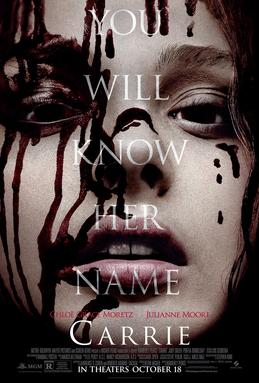
So my complaints for the 2002 version of Carrie were plentiful and, dare I say, justified. I am so good at watching movies, you guys. So good.
I will concede that many of those complaints were rooted in the poor production, inception, and intended release format. If a movie is meant to be released on TV, then it’s gonna be pretty bad. The creators are gonna cut corners, they’re not gonna waste time thinking, they’re not going to want to look back on their work. I expect that the quality is just a consequence of the intention. So perhaps that movie was meant to be that way. That the producers wanted to aim it at a specific audience. An audience that I am struggling not to insult.
This version, released in 2013, did hit theaters. It had significant actors attached to it. So, by design, this film was meant to be good- at the very least, better than the 2002 iteration. And it was! Spoilers!
Almost as if made for me and this review, the 2013 film understands its core story, the characters, and their actions, pretty well. It even expands on these elements, redefining and refining the 1976 film. Carrie’s powers, when they begin to manifest, feel sufficiently accidental. They’re as ambiguous as you need them to be, and when she begins honing them, it feels so believable.
I also enjoyed that this film took an alternative stab at the bullying element. Especially at first, the way the other girls bully Carrie can be easily construed as ‘misunderstood’. Yes, there are some explicit moments of malice, but a lot of it could just be seen as friendly ribbing. Hell, in one of the first scenes (changed from regular volleyball to pool volleyball), when Carrie accidentally knocks the ball at someone’s head, it’s laughed off. It’s Carrie’s own guilt that leads to her feeling like she’s being bullied.
The characterization of the supporting cast is elevated too. Sue, the girl who volunteers her boyfriend to go to prom with Carrie, and Tommy, aforementioned boyfriend, played by Ansel Elgort in his first feature film, were some of the biggest beneficiaries of the effort put into the writing.

They display a very refreshing amount of humanity. They admit they’ve been dicks before, but they also express regret- and when Sue realizes she didn’t apologize to Carrie, it gives a meaningful, convincing inciting moment for her action of making Tommy ask Carrie out. And to his credit, Tommy is a really standup guy. It’s nice to see, as the audience, but the film does an excellent job of veiling these good actions behind Carrie’s insecure perception of the world around her.
The film goes on to close certain gaps in the 1976 film- such as when Tommy says he asks Carrie out because of the poem she read. We never saw that poem reading. We just shrugged and moved on. We got to see it here. It even gives Tommy a moment to stand up for her when the teacher expressly bullies Carrie.
I could go on: The principal misnaming Carrie is more natural and accidental. The gym teacher’s encouragement of Carrie to go with Tommy didn’t feel selfish, but truly encouraging. Chris and her asshole lawyer dad’s relationship makes more sense (the latter is the former’s bully). I haven’t begun to discuss all the new developments in the relationship between Carrie and her mother.
All of that is to say, I really, really liked the way they adapted the 2013 film. It ticks so many boxes, remains grounded in its filmmaking, revitalizes the story, closes so many loops, and adds a layer of logic that was missing in the 1976 version. Like my viewings of Let the Right One In and Let Me In, I think that this adaptation works really well. But it’s safe.
Yes, the writing was much improved, to the point that it added to the original story. Nothing was detracted, but more depth and complexities were added. This helped round out the story and the film. So while this film was great compared to the 2003 version, it lacked the charm, the visually artistic flair, and the personality of the original 1976 film.
I think one of the most critical aspects of the original Carrie that I enjoyed was not the story, nor the characters. I didn’t care for the horror or thriller or supernatural elements. I overlooked the little things. Why? Because the film was so damn pleasing to look at. There were pockets of fun, inventive effort littered throughout. It made for a rewarding, visually aesthetic expression of inventive, thoughtful filmmaking. So while the 2013 Carrie has the better script, I still think the 1976 Carrie is the best version. The 2013 Carrie is a fantastic example of well-rounded writing, the 1976 Carrie felt like better… filmmaking. And isn’t that what we’re talking about here? The holistic view of the visuals and audio coming together? You can’t sacrifice one for the other. If one element is mid, the other must excel.
Finally we come to the question: would people like this movie? Did the adaptation do enough to get more people invested? Will the story resonate with this generation’s audiences? Uh. Maybe. I feel like bullying is never as bad as the movies make it out to be.
YMMV
Guys remember when I did a 4-film review of Twilight? ‘member? This felt like a different beast. I didn’t have a vision for this unified review going into it, but it felt natural to do a side-by-side comparison. It made certain successful elements of the film stand out, and highlighted that other portions of it left much to be desired. It’s in line with the thinking ‘you learn more from your mistakes’, where you can see how different creatives expressed the films in different ways. I was most frustrated with the 2002 movie not because it sucked, but because it wasn’t thoughtful. The 2013 version was just solid, grounded, textbook filmmaking, but it didn’t feel artistic. It still felt like a play-by-play film that was given a task. The original 1976 version left something to be desired in certain story beats, but it felt like the most like an expression. It made me feel. Perhaps, the next time we watch a film, we can feel better knowing when we get a thought like, “No, this could’ve been done or shown better”. Oftentimes, it can be.
The Carrie movies were on acclaimed streaming service, Tubi, but can find the here:
 85scenes Reviews
Leave a comment