
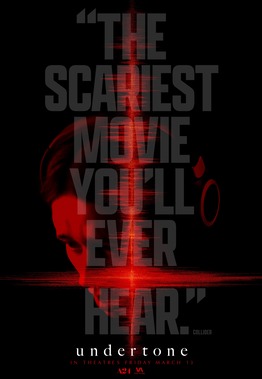
The A24 film Undertone is yet another horror film that you were told was “so good” and “you just can’t miss”. If you looked it up, you probably saw the terms “sound design” and “audio” and “acoustics”. I’m here to tell you that if you watched the movie, and that was your takeaway? I think you missed something.
The Sound of Clickbait
Right. Sorry. I just like seeing the viewcount climb when I emulate “cracked.com”’s engagement efforts, so uh. Deal with it. I guess.
Hey, remember when I said I like Catholic horror and possessions? Yeah. That’s what this movie is. Undertone is a Catholic possession horror. Surprise!
But Undertone is more than that, actually. See, people aren’t wrong when discussing the movie’s sound design or acoustics. Yes- absolutely- Undertone’s sound design is absolutely magnificent, and so much of the horror is due to the way the music designs its sound, the way it draws you in with noises, confusing you with whether or not what you hear is from the computer or happening in real life.
So if that’s what you honed in on and feared, yeah, you’re right! You’re not totally wrong! But you’re also not completely correct. I think you missed out on just a little bit.
Seen and Unseen
You may notice that a few people, if you dig enough, mentioned the movie Skinamarink. It’s a movie that I have never, ever talked about, ever. I probably haven’t mentioned it in other reviews. I don’t even remember if I saw it. In any case, they’re not wrong either.
There’s a lot of Skinamarink in Undertone, but not enough that it suffers from the same gravitational “huh?” that the former was dragged down by. I may or may not have stated the following about the film:
“The dialogue is sparse and difficult to hear and understand, and the focal points of each frame is not traditional. You can call it an experimental film due to the extreme deviances in the film from standard filmmaking.”
What Skinamarink did was take the visual elements that define horror and cranked them to 11. I only said 11 because the colloquial phrase is “cranked it to 11” but truthfully, Skinamarink is the visuals of horror turned to a 20. Unfortunately, that isn’t as catchy. What Undertone does is dial back that Skinamarink visual horror and adds in what the originator film was missing.
Again, it would be catchy if I just said one thing, like, say, “what the originator film was missing: a compelling audio”, or “a comprehensible narrative”. But again, truthfully, what Undertone did was not as catchy. It did both. The sound design and the narrative both are boosted relative to Skinamarink, and I think that that choice does a great service for our titular film. The result is not only a more generally intelligible film, but one that has more space for the director to be creative.
By including a narrative, dialogue, conversations, and dynamics more mature than just what a child may experience, Undertone allows itself a more complex story. A story that has more to understand, more to deduce, more to consume.
It’s pretty surface level that the film wants you to be at the intersection of abortion, Catholic guilt, and a supernatural punishment for unmarried intercourse due to the heavy Christian misc-en-scen throughout the film. And if you’re a horror fan, you probably notice this kind of thing in other horror films a lot.
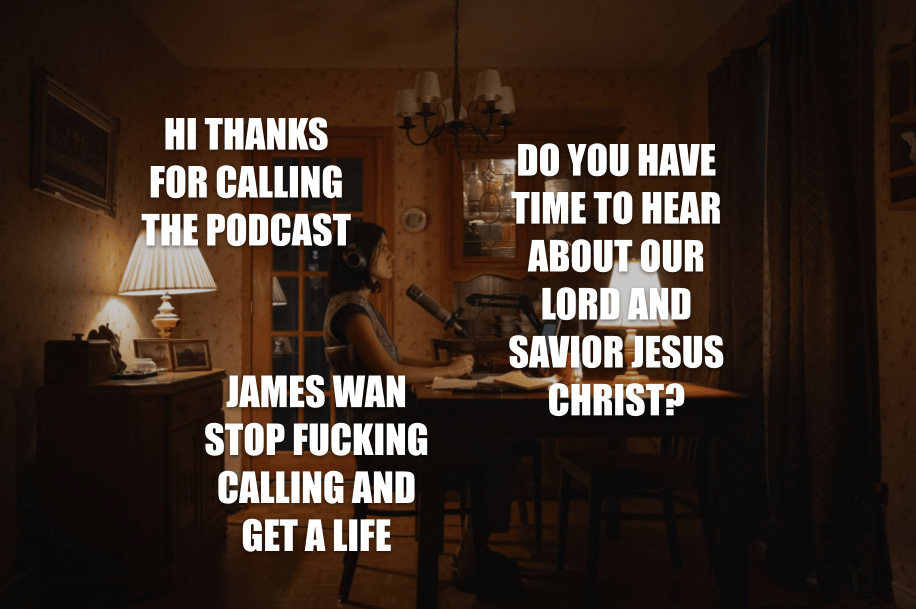
Where Skinamarink decided to unsettle us with every single visual through a darkened, shadowy, abnormal view of the normal, Undertone chooses to fill its frames with a nearly obvious backdrop of religion informing the emotions of a young woman who finds herself pregnant out of wedlock. Throw in a demon who specifically preys on babies, and we’ve got ourselves a relatively straightforward story that has every avenue to get scary and grotesque.
This is where the movie excels and where the audience fails, and it all begins with off-centered shots of our protagonist. The focus is off to the side, and where we would usually look, leaving the middle of the screen empty. A darkness for us to shift our gaze to and fill with our anxiety. Forget whatever acting we see from actress Nina Kiri, all we see is the dark hall, or a still staircase or an empty room. We assume that we get the movie. There’s something in the shadows! And it’s related to religion! We think we get where it’s going and what the story is.
Then we get the climax.
What did I Miss?
The film sets itself up to be a story of abortion and guilt, bastards, and slutty moms. Yeah, I know I said it too earlier in this review. But that’s not all.
The film opens very differently. It’s the sound of a labored breath, a comatose mother, a dutiful daughter. The film ends with our protagonist “admitting” that she killed her mother. An empty hospital bed. No further mentions of a pregnancy. Finally, let’s consider the only visual actors in this film: the mother. the daughter.
I don’t think that, at the end of the day, Undertone was about just abortion and Catholic guilt. I think it was about womanhood. It felt like a compressed, encapsulated story about motherhood, caretakers, and guardians. The burden that they face, the difficulties that a keeper of another human deals with, the sacrifices one makes when taking charge of the wellbeing of another. Mothers take charge of helpless babies (if the men are absent like in real life, or visually, like in Undertone), and children take charge of their helpless parents.
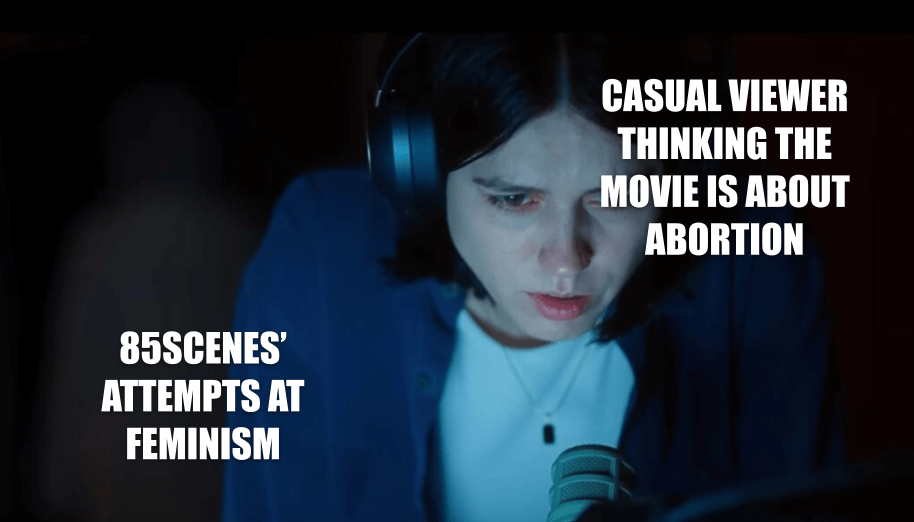
It’s not just about Catholic guilt surrounding unmarried sex and intercourse and banging uglies with a useless boyfriend who throws parties on your behalf. It’s about the guilt surrounding the unverbalized desires when you’re supposed to or expected to care for someone who can’t care for themselves. It’s about the demons you face, internally, when trying to balance your desires with your duties.
The key to this interpretation is a scene where the protagonist decides to go to her useless boyfriend’s party. She’s delayed because she has to clean her mother who soiled herself, and then doesn’t return in her promised “few hours”, but instead waltzes in the next morning. When she does, she finds her mother collapsed on the ground, seemingly because she tried to get out of bed on her own.
The scene plays much like if a mom decided to leave her baby behind for a night, changed the baby’s diaper before leaving, then came home to the baby screaming and crying with a leaky diaper because it was untended.
The protagonist, who is struggling to be the 20-something young woman she is, begins and ends the film with duties and guilt over her failures as a caretaker.
So if you read all the comments about people being confused, or if you yourself felt confused by the ending of Undertone, I think this new interpretation will help you understand a new dynamic of the film. One that most people missed because they were consumed by the sound design, or caught up in the topical issue of abortion.
Conclusion
So what did you miss in the film Undertone? I think a lot of people missed that the cinematography plays a huge part in building the horror, but I didn’t talk about that much aside from alluding to Skinamarink. That’s not to say that the sound design wasn’t incredible. But I think what people missed was that the movie wasn’t about babies, but about adult children and their old parent babies, and that it sucks in a lot of ways to have to be in charge of a person’s wellbeing if you also want to live your own life. And that babies crying is a horrible sound make it stop.
I rate Undertone
GOOD
I watched Undertone on HBO.



Leave a comment