
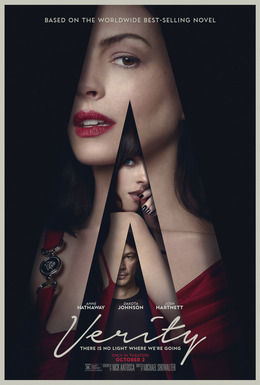
Every time I watch a mediocre movie, I think to myself, “well, this is gonna be a short review!” Let’s see if Verity offers me such a luxury.
Men in Women’s Dominate Fields
Let’s just be honest here. Why did we go see this movie? Why did it get such a splash? What drew me and my male buddy, both of whom are attracted to attractive women, into a thriller based on a novel written by a woman?
I don’t mind the marketing ploy. I don’t even feel shortchanged by the fact that there’s only one scene of romantic or sexual tension (or… if we’re being honest… any tension at all…) between Dakota Johnson and Anne Hathaway. I mean. It’s a steamy movie. But the only man in the room who benefits from the steaminess is Josh Hartnett.
In fact, I really enjoyed the ride that the movie took me on. It wasn’t some masterpiece. It was actually actively laughable. There was a beautiful, gorgeous moment where Dakota Johnson, with full sincerity, says, “You can’t kill her that way. They’ll know it was you. You’ll have to fake it.” Then describes how Hartnett is to kill said victim. The whole theater laughed. Me. My cinefile buddy. The old couple, where the guy was clearly dragged into the movie because the wife was owed a date. The young, hot Indian couple who clearly only showed up (judging by their clothes) because they thought the theater would be empty. The two women who looked like they worked full time at the 7/11 who sat in the very front row. The idiots who thought buying the AMC microwave pizza and bagged queso for their nachos was a night out. We all laughed. Together. Hilarious. Laugh out loud.
Humiliating, really, for the movie and the writer.
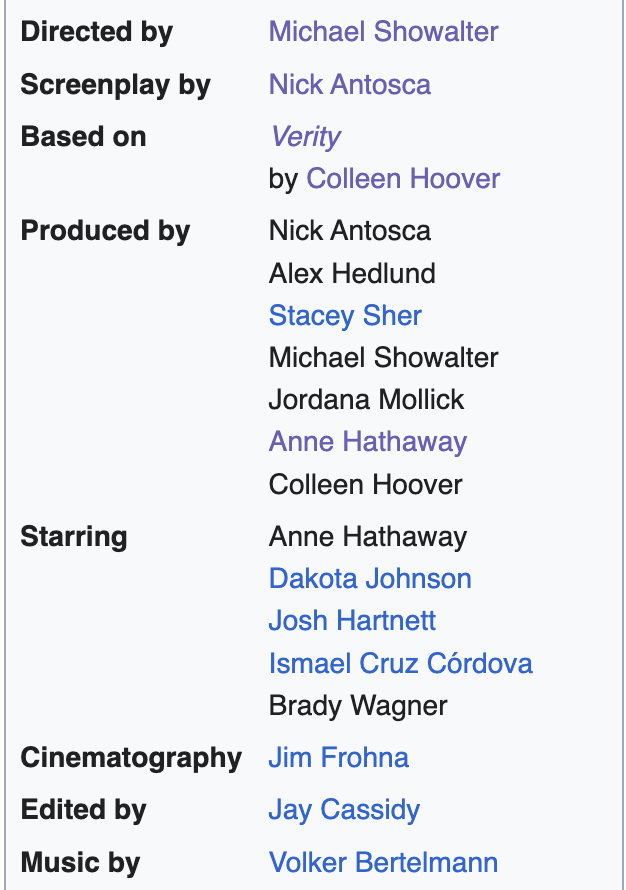
Speaking of the writer (screenwriter), and I promise I was leading to this, is Nick Antosca. A dude. Responsible for… really nothing very notable. A few shows, and three other movies no one watched. But then you’d think, “Hm. Maybe they trusted Kathryn Bigelow, or Chloé Zhao, or Emerald Fennell, or Sofia Coppola to direct a movie about two women.” Nope. They got the guy from The Big Sick and The Idea of You. Funny enough, I have a million thoughts on that latter film, but no review. Odd.
Female original author. Male director. Male screenplay writer. Two female protagonists. Two male friends in attendance.
Feels off, no?
Then we get to the fucking themes presented in the movie. Now, unreliable narrator themes and “murder mystery authors could probably get away with murder” tropes aside, there were a number of very… female-centric themes in this movie. SIDS (Sudden Infant Death Syndrome) made an appearance, alongside undiagnosed unspoken PPD (Post-Partum Depression), feminine jealousy, domestic abuse, and the female spouse being far more financially successful than the male spouse but still being relegated to domestic duties.
You’d think that more women would be involved in this movie, right?
Writing Writers
Strike one against Verity and the men involved. That leads to strike two.
What a goddamn stupid opening scene. Unlike The Uprising, I don’t totally remember the opening dialogues from Verity, but the setup was Anne Hathaway, playing megasuccessful author Verity Crawford, being interviewed by discount Oprah. Discount Oprah glazes Verity for being a successful, nay badass, author. How does she feel about providing for her family? CUT TO BLACK.
Christ.
The crap dialogue was ever present in this film. Almost every line, nearly every interaction, pretty much every single scene. Just a pastiche of ideas, but none that connect. I cannot tell you just how cheap, tropified, and garbage the dialogue is in this film. I point to the aforementioned theater-wide laugh we got at, what the movie thought was, the most dramatic moment in the film. Each scene, every damn time two people interact- it’s fucking basic and garbage and simplified and trash.
If I was Colleen Hoover, the author of the book this movie is based on, I’d be pissed. I have no idea how much the movie lifted from her novel, or how much of the dialogue was based on Hoover’s words, but I hope the answer is none at all. However, considering Hoover has published 3.91 books a year between 2012 and 2022, I’m worried that… maybe…
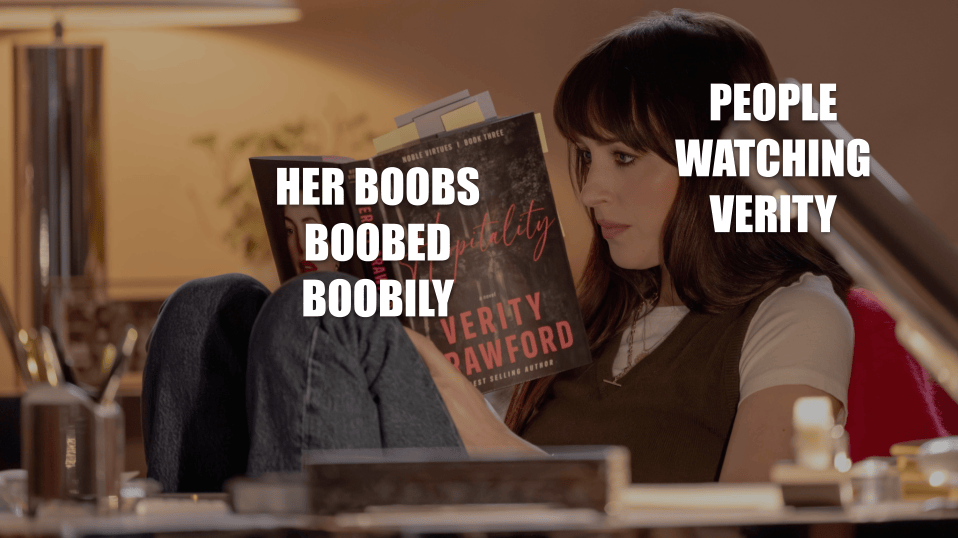
Then we get into the whole self-indulgent, nigh-masturbatory act of writing a story about a writer. Hell. Not just one writer, but two writers. It’s hard to experience a story about writers knowing that it was written by, of course, a writer. It’s not weird if someone writes about an assassin, or a rich playboy, or a basic waitress who ends up with a rich playboy, or a forgettable boy who’s granted powers, or, really, anything from the entire body of all of fiction. That’s not weird. It’s a little dicey if a writer writes a writer as the protagonist. Also, if you think I’m missing a huge point of consideration regarding writer Colleen Hoover at this point, I urge you to skip down (or wait) for my bonus section.
The circumstances, traits, behaviors, actions, reactions, consequences, and feelings all reflect, at some level, what a writer thinks, hopes, believes, or fears will befall them. There is no experience that is more lived, for a writer, than being a writer. Being a writer means that all of your life experiences are distilled, reflected, and then regurgitated into your words. You can flower them up with adjectives and metaphors, you can embellish your characters with distinct traits, you can exaggerate situations and consequences to drive up the drama, horror, shock, or humor of an everyday situation. Hell, I have a running note of interesting things I see in life that eventually makes its way into my fiction writing, a list titled “Interesting Critters”. Again, if you’re clawing at the walls because you think I’m skipping over some juicy Colleen Hoover talking points: bonus section.
So when other writers write about writers as their protagonists (or antagonists), there’s a very justified raised eyebrow when you analyze the writers the writer has written. Again, bonus section.
That’s all I think I need to say about that. If you watch the movie, I think you’re going to come to some very… colorful… conclusions. In fact, if you’re really tuned into the writer’s experience, it’s likely you’re going to buy into the ‘unreliable narrator’ trope far more. Or far less. Or the same. Writers are stupid and hard to predict. Or, as Dakota Johnson claims, as she plays writer Lowen Ashleigh, “writers usually are [disorganized].”
Imposters and Imposter Syndrome
So I couldn’t keep this review compact. This got out of hand, because I definitely had a lot more thoughts I wanted to get out. One of the things I wanted to talk about, and hopefully get feedback on (like, comment, and subscribe you guys!) was the fact that the film tried so, so hard to develop Johnson’s character as an unreliable narrator. Unfortunately, the film wasted its first half entirely. No tension, no drama, and no ambiguity. No one gaslighting her, no one really introducing the idea into our minds, as an audience, that Johnson couldn’t be trusted.
If you watch the movie, you’re going to think that the few scenes where Hathaway is implied to not be comatose, as suggested by the trailer, is the film developing Johnson’s unstableness, then you’d be wrong. No one really, convincingly tells Johnson that she’s wrong, or mistaken. Hartnett gets a shot at it, once, but it’s very late in the film. Late enough for most people to have figured out a theory for the ending, an ending that would only feel encouraged by his behavior, not confused by Johnson’s.
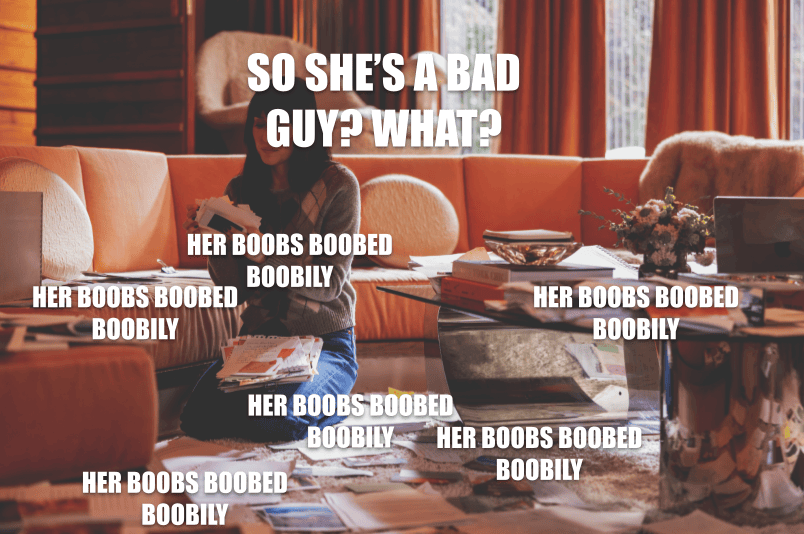
The “unreliable narrator” moments really only manifest towards the end of the film, right at around the time that, again, you have guesses as to where the movie is going. For a film to effectively set up this trope, the unreliability and the weirdness needs to begin far earlier in the film. As of the publishing of this review, but not the writing, I wrote about The Lighthouse, a link that won’t work until, probably, December 15th, 2026. The Lighthouse, if you want to go read the Wiki synopsis, is based on Robert Pattinson being very unreliable as a protagonist. At ten minutes into the movie, we’re introduced to a confusing, incomprehensible, but narratively promising sequence. It sets the absolute tone for not being able to trust your eyes.
So the straightforward narrative, one where Dakota Johnson is forced to go back to New York, a city where she was forced to film both Materialists (a film that holds a special place in my heart for contextual events) and Madame Webb (a film that holds a special place in my heart for being horrible), never sets up to be any sort of ambiguous. In fact, even the Xanax and alcohol abuse implications barely establish themselves. If you want to challenge me on this substance abuse point, fucking comment on this review. I’ll fucking eviscerate you when it comes to addict behaviors.
Conclusion
Quite neatly, I’ve run out of things I want to talk about. To conclude: only one sexy scene, horrible writing, and a major lack of a feminine presence in the production of this film leads to a garbage movie. Also, there’s some really trash jumpscares in this movie for no real reason. I will say, though, that the comatose Anne Hathaway idea did get me quite tense. I knew that there was going to be a big reveal, but the tension leading up to such a reveal, despite the filmmakers’ worst efforts, was real. The reveal was underwhelming.
I rated Verity
BAD
Not even Dakota Johnson and a sparingly used Anne Hathaway could save the film that I saw in theaters. I expect to see Verity on some streaming platform at some point soon. You’d do well to wait until it reaches said platform, because there are a lot of other movies that deserve your money over Verity.
I do not apologize for spending 1691 words talking about Verity.
Bonus Section! Women, Amirite?
Much like Taika Waititi and George Lucas‘ early successes being attributed to women, I will now be taking credit for a woman who makes me better. Turns out, not being a reader has bit me in this ass while talking about this film. Approximately 12 hours before this review was set to be published, I, alone, without prompting, and without my beautiful, intelligent female fiance editing and reviewing my article, discovered who Colleen Hoover was.
Colleen Hoover hit the zeitgeist during the pandemic, and her massive backlog (an insane 3.91 books per year) burst onto the “BookTok” scene. Her books, often marketed as young adult novels, were aimed at immature, impressionable youth. The same people who the law protects from statutory sex for being mentally and emotionally underdeveloped.
“But 85scenes, what’s wrong with kids enjoying novels written by women? I thought you were a feminist!” You may ask. What are you, some fraud? You sexist bastard! I knew it! God you’re hot.” You may probably continue to say.
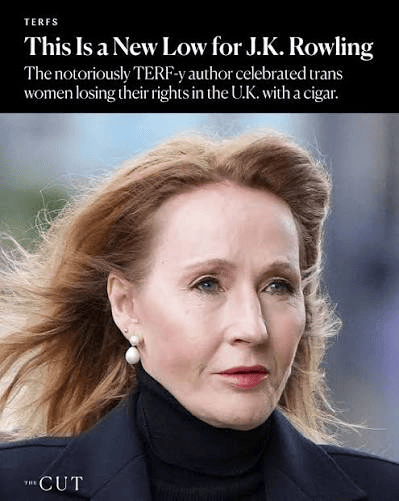
Women are not infallible. And, it turns out, that being raised in the ass-burbs of the Dallas-Fort Worth metroplex does set up a blonde white woman to learn healthy relationships. It also explains why, in Verity, the only person of color was the Oprah knock off, who got 5 seconds of screentime and half a dozen crappy, cliche lines.
The biggest issue, however, is that her novels seem to romanticize domestic violence. That her writing glazes over and normalizes violence against women, almost dismissing it as a routine, acceptable occurance. Don’t believe me? Maybe you’ll be believe this random redditor! Or maybe this redditor. Or this YouTuber. So, in realizing that these themes are being proliferated and glazed over as a common, permissable experience for women, I suddenly feel extremely validated in my disdain for the film, the various sections I highlighted, and my refusal to read.
The rest of this review is just me glazing my own writing. As I so eloquently called it above, “self-indulgent, nigh-masturbatory act of writing”. First, my memes, the “boobily boobed” memes, are a play on men writing women’s points of view and having a severe misunderstanding of how women experience, comment on, and interact with their own bodies. At its core, the joke is, “wow look, bad writer!” Turns out I was spot on.
Bear with me here, I plan on explaining all of my jokes so you guys really get it.
Just kidding. I’m done. I just thought it was a good idea to admit that I missed a major point in discussing this review. And also that I figured all of this out on my own. All of it. No woman helped me be better.



Leave a Reply