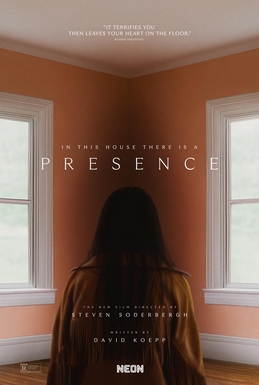
First off, the movie Presence is not a horror. It’s a study. It’s a demonstration of perspective, of misdirection, of character work, and of excellent filmmaking. So let’s get that straight. Not a horror. Further, this review is one of the few times I will not be spoiling the movie.
A Lesson For Kids
Standard films use a camera in standard ways with standard characters and standard arcs. Using standards allows for standard audiences to understand standard ideas and allows for a way to standardize the storytelling.
Some movies are not standard. Some movies find and pick a specific idea or norm, and break only that rule. Break too many rules, and the movie begins to fall into chaos, and sometimes, incomprehensibility. Finding a rule to break and re-invent is what distinguishes talent in a storyteller. Skinamarink broke the rules by never telling us what was within the darkness, and made us stare and guess for a very long time. Longer than a standard movie like one of the The Conjuring flicks. The movie In a Violent Nature draws a circle around the narrative and spends most of its time outside that circle, compared to most movies, which take place entirely within that circle. Some movies break the rule that a story needs to be told in chronological order, like Memento.
Some movies, like Megan is Missing, decide that the rule to break involves not sexualizing teenage girls. Perhaps we should not break some rules.
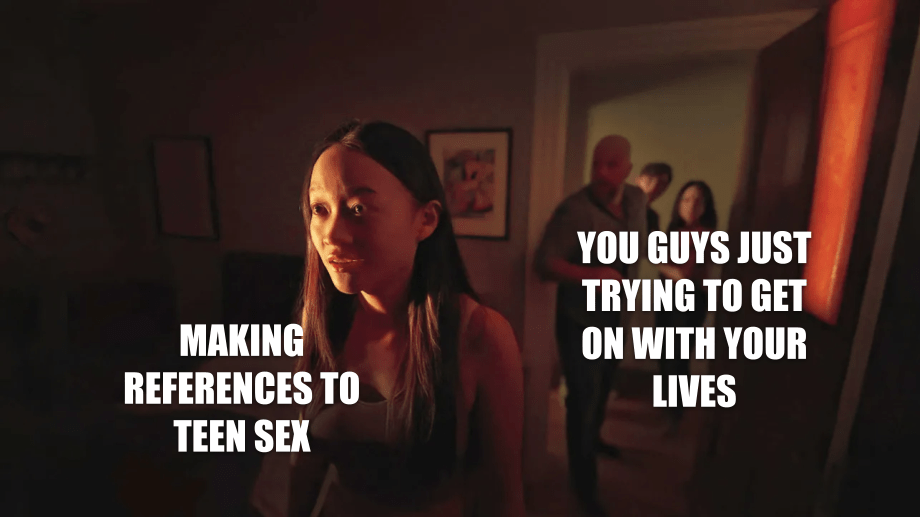
However, Soderbergh utilizes the fact that while the camera is meant to be a voyeur into a story, it can be integrated into picking specific parts and moments of the life of a character. He’s breaking the rule that the camera isn’t its own person by embracing that sometimes the audience is a secret character. What a standard story does is that it truncates what is a real life journey into 90 minutes. When the camera is the one choosing what to see and when, it turns into a storytelling device within a storytelling device.
You may be wondering why I spent so long explaining the draw of the movie Presence when it’s pretty obvious from the trailer what’s happening. It has to do with birds and teens.
A Lesson in Birds
Many of you may have heard of terms such as “Chechov’s Gun”, or “Red Herring”, or “Macguffin”, or “Foreshadowing”. These terms constitute shorthand for various tropes and cliches and techniques that storytellers use to keep the audience from piecing together the puzzle of the story while still giving clues to the ending. These, and other tools, are used to ensure that the filmmakers maintain control of a film as the story is being told by providing a controlled amount of chaos and obfuscation that viewers would find satisfying.
These tools are especially useful in stories that involve mysteries, and less discussed, stories that involve insurmountable odds. A good horror film involves both of these obstacles for their characters. That’s part of the reason why people think that Presence is a horror. Just because there’s a ghost doesn’t mean scary. Sometimes it means sexy, too.
That said, this movie features a sex scene with a teenage girl!
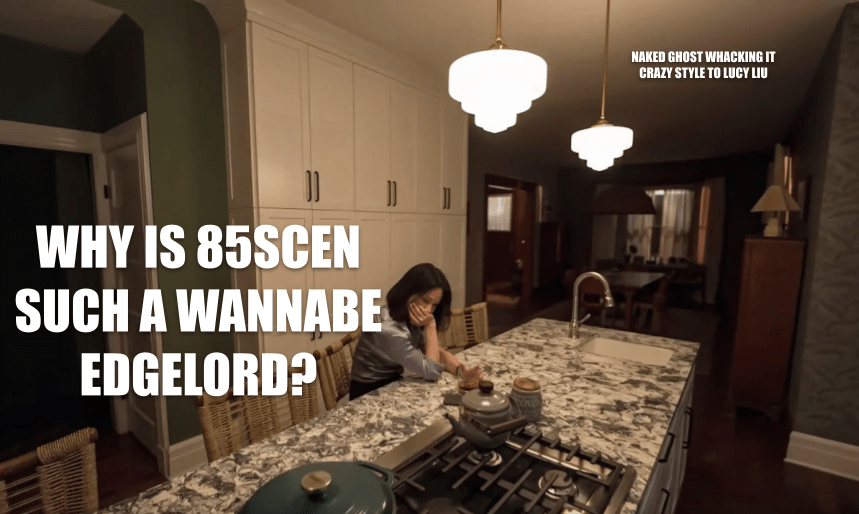
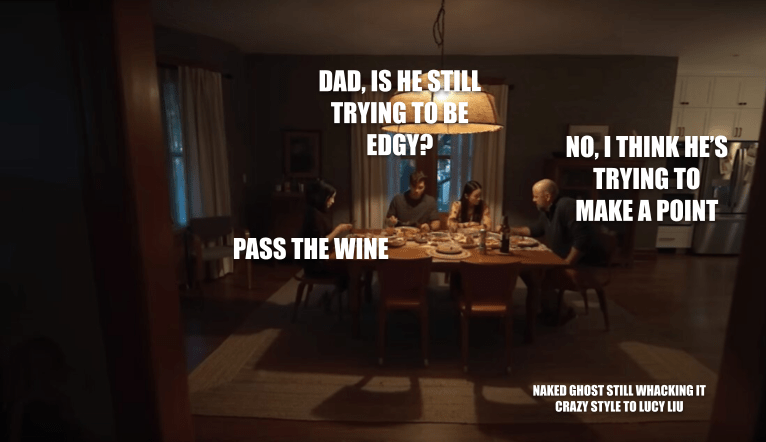
Played by Lucy Liu, the mother of this family is a selfish alcoholic with a mystery job and clear favoritism for her son. Liu, an Asian, plays an Asian with two Asian kids and a white dad. Race was not explicitly implied to be a reason she likes the boy more than the girl offspring, but y’know. Asian moms, amirite?
The film emphasizes Liu’s character as a poor parent who is involved in a tense and legally dangerous scheme from work. She gets wasted often, sometimes being inappropriately emotionally intimate with her son, and frequently arguing with her relatively reasonable husband.
Liu’s character and journey is, as they would say, a Red Herring. Some would say I Foreshadowed the story of Presence through my explanation of perspectives and the specific movies I chose to use as examples in this article. Perhaps the teen+sex jokes were MacGuffins to redirect your attention from the fact that I was actually talking about the movie. I couldn’t figure out how to work in a Chekhov’s Gun, so here’s a scene from Hereditary:
A Lesson For Me
Today, I learned that what may feel like a short story on paper could be reasonably stretched out like plastic wrap to a feature length, as long as that time is used to tell us more about the characters. Each new detail, even if it’s a misdirect, needs to help us understand who these people are, what they believe in, and how their emotions are affected by the events of the story. When breaking certain filmmaking rules, it’s important to justify the breaking of the rules by then utilizing the freedom to better tell a story within the other, unbroken, rules. That’s the key difference between a rule being broken for the sake of breaking it, and a rule being broken to try and do something better within normal bounds to achieve something novel.
As such, the running POV technique of the film Presence was well used, and demonstrates that such a perspective can be used to invoke emotion and innovation. The acting from our cast was solid, the story was emotionally scarring, the cinematography was well crafted, and my only issue with the film was that the ultimate antagonist was kind of lame.
This is the kind of movie where you’ll be saddened and scared only at the end, and you’ll find yourself itching to rewatch the film. At the very least, Presence will have you reconsidering every scene and every interaction. If it resonated with you earlier, the movie will etch itself over in your mind as you process the end. This emotional impact may have been captured had the film been made using standard camera movements, but putting us in the camera’s seat only deepens the feelings- especially after the movie ends.
Despite the fact that I don’t believe everyone will enjoy this movie, I still consider it