
As I was leaving the movie theater, I walked past a group of people who had been in the screening of Lord of the Rings: The Battle of the Rohirrim with me. As I passed them, one of the men said, “The writing wasn’t very good”, then chuckled as if looking for approval. His friend replied, “Well actually, I thought it was alright.” The woman who was with them began saying something, but I kept going because who cares what women say.
But this exchange got me thinking. Did this movie have good writing? What is good writing? The dialogue was ok. They had some cool literary devices throughout. The story was meh. What’s the difference? So on the drive home, I broke it down.
The Story
Yes, you technically ‘write’ a story, and as such, the story is ‘writing’. But also, technically, you fucking know it all, you ‘write’ a soundtrack too, but we don’t call that writing.
The story is an overarching tale. The journey from beginning to end in simple terms. A summary. The story of Lotr: WofR is of Hera, and the role she plays in a scuffle between her hotheaded father Helm Hammerhand, and some revenge-addled incel named Wulf. The summary is that Wulf wanted to marry Hera, she implied she’s a lesbian, Helm accidentally killed Wulf’s dad, Wulf started a war, Helm was a sexist, macho meathead, Wulf pushed Helm back into the Hurnburg, some shit about Helm being a dumb meathead again, then Hera 1v1ing Wulf and beating him, then roll credits.

Yes. That’s the story. Yes, the neckbeard who thought “the writing was bad” may be right.
So now you’re thinking, “hey dude. You’re just cherry-picking details to make this movie sound bad”. Ok. Fine. Here’s a summary for The Karate Kid from Wikipedia:
“The Karate Kid follows the story of Daniel LaRusso (Macchio), an Italian-American teenager from New Jersey who moves with his widowed mother to the Reseda neighborhood of Los Angeles. There, LaRusso encounters harassment from his new bullies, one of whom is Johnny Lawrence (Zabka), the ex-boyfriend of LaRusso’s love interest, Ali Mills (Shue). LaRusso is taught karate by a handyman and war veteran named Mr. Miyagi (Morita) to help LaRusso defend himself and compete in a karate tournament against his bullies.”
Interesting, right? Here’s another summary for a film that you get to guess:
“A globetrotting archaeologist vying with […] forces to recover the […] which is said to […]. Teaming up with his tough former romantic interest Marion Ravenwood (Karen Allen), Jones races to stop rival archaeologist […] from guiding the […] to the […] and its power.”
And uno mas:
“ […] pits Indiana Jones against […] agents […] searching for […] located in […]. Jones is aided by his former lover, Marion Ravenwood (Karen Allen), and […]”
Which film is better? Which story is better? Do you know which description lines up with Temple of the Crystal Skull and which lines up with Raiders of the Lost Ark? No. Not from my cherry-picked summaries.
See, the thing is, any story can be good. Any story. And by good, I mean, “good to experience”. I’ve seen shit retellings of the Indian retelling of the Mahabharat:
But when my mother told me this story, this shit was fucking inspirational. The story itself is not writing. It’s not even indicative of the quality of the film, or the experience. Hell, if you want to remove the bias, let’s look at wikipedia’s summary for WotR:

Is that it? Really? That doesn’t sound “very good” according to the neckbeard I passed in the lobby of the movie theater.
The Dialogue
Remember how the original LotR movies were dreamy and slow and sounded old and medieval? Let’s take Theoden’s battle cry, for example:
Arise now, arise, Riders of Théoden!
Dire deeds awake: dark is it eastward.
Let horse be bridled, horn be sounded!
Forth Eorlingas!
That sounds dope as shit. No one talks like that, but we fucking get it. Get hype, bitches. That’s good shit. He spoke that shit. Let’s take another classic line, for example.
No, you clearly don’t know who you’re talking to, so let me clue you in. I am not in danger, Skyler. I am the danger! A guy opens his door and gets shot and you think that of me? No. I am the one who knocks!
That’s Walter White. That’s good shit too. Dangerous. Bold. Full of personality. Good shit, right? Here’s another example.
This is actually good writing, actually. It’s fantastic dialogue. It’s funny, it’s full of character. You learn about who the director is, who the writer is, who the producer is, who the audience is. You learn about who wants what. It helps give substance to the relationship between Sam and his dad. It speaks to the theme of the movie (I use the word ‘theme’ loosely) Hell, we even get insight into Bobby Bolivar’s personality. What’s more, the scene keeps the story flowing.
As an aside, that link is actually one of my favorite fucking clips from the first Transformers movie. I know I talk about it a lot, and I know some of you think I’m a moron for it, but I’m not perturbed. I solemnly believe that Michael Bay, as dumb as his movies are, provides an incredible value to the world of filmmaking. I’m not justifying this shit any more than I already have, but I just gotta say. That clip, right there? It wasn’t even something I was thinking about when I think of good writing. But it is. It’s fantastic writing. But more specifically, that clip, and the other excerpts I provided, are fantastic dialogue. The dialogue is written, more directly than you’d write the song or a lyric. Even more directly than you’d write the story. This is writing character.
I write other shit in my free time, not just movie reviews that dickride Bay. I know, from experience, and from anecdotes of other writers, that good- great- characters write themselves. They form their existence, and morph the story. Great films, great tales, allow the characters and their words to form the direction of the story- not the other way around.
When the story propels the characters forward, we get shit like The Phantom Menace or Borderlands, wherein the necessity of the story overrides the individual drives and motivations. The destination defines the captain. That’s not interesting. We don’t care about the dad driving his kids to Disneyland, we care about how often his wife stops for a pee break then vapes in the bathroom because she’s tired of kids and hates Disney. Same, sister. Same.
So. Is dialogue writing? Sure! But is that what writing is? Capital dub writing? Mayhaps. Now let’s take a look at motifs, because I’m a fucking prude.
The Metaphor Synonym
Remember when your dumbass English teacher was like, “what’s a simile” and the cute nerd named Alyssa was like, “It’s when you use the words ‘like’ or ‘as’”, then the idiot teacher with a hole in the armpit of her shirt was like, “what’s a metaphor”, and the blond, blue-eyed moron named Pavell who was fucking the cheerleading captain knew what it was? Remember when you felt like shit because you couldn’t answer, and fourteen years later, you still don’t know?
No?
Really?
Is this just an anecdote?
This metaphor thing is actually pretty easy. It’s like having to eat a tasty baked treat. Ever seen a horror movie? Any good scary movie? Let’s talk about Malignant, because it’s the easiest of easy. The film initially went way over my head the first time I saw it because I thought it was dumb and campy, but there’s a solid theory that the movie was meant to be campy and ironic.
The film (loosely) explores concepts of domestic abuse, and the idea that this type of evil can come from within. That dormant within ourselves is an anger that can cause severe harm to our close ones. The parasitic twin who controls the main character’s body represents this internal anger, and its actions mimic those who commit abuse on their families. This is a loose example of metaphors, but it’s there.
Another horror film, Skinamarink, uses similar techniques and similar themes. When the kids are stuck in their homes when the doors and windows disappear, there’s a very tense, scary sequence where they sort of see their mother on her bed, but she’s not really there. This is a pretty decent demonstration of what it must feel like for children who are being neglected by their parents. The parents are there, but they’re not truly present in their kids’ lives. The children are imprisoned in their home with only their toys and their TV for company. The horror of the film parallels the slow, crawling fear the kids feel in their day to day life.
A very obvious example comes in the form of Moby Dick in which case the metaphor is the size of a whale. If you want something more contemporary, and arguably less effective, is the entirety of the film Don’t Look Up. The film is an on-the-nose parallel of American politics as the smart people panic about an incoming meteor, but everyone else is ‘pro jobs’.
Across all of these examples, the object of the metaphor is a stand-in for some other, complex non-physical issue. This type of writing is hard, actually, as you need this non-interactive object to be treated as, and behave as, the actual theme. Themes, when good, are typically more girthy and unwieldy, and don’t easily entertain when it comes to films. It’s like if you tried to make a movie about the arrogance and downfall of a rich guy (Citizen Kane), or a movie about a guy with an ego realizing he’s a dick, and then he dies (The Green Knight), or a movie about a girl grieving over her own mortality while also buying some clothes (Personal Shopper).
The theme is the message you wish to convey, but the metaphor is a way for you to be able to explain the theme in an easy to understand, visual, cinematic way. It’s easy to fuck this up, though, and people mess this part up a lot.
In the film Talk to Me, the overarching theme is about responsible fatherhood, and how different parents turn to different things to raise their kids. This theme doesn’t really get a proper resolution, as the film culminates in a violent fight and escape. You could look at The Pod Generation, which wants to talk about the intersection of parenthood and technology, and how involved technology should be in parenthood, but the film ends without properly stating what its view is. This reason is why I didn’t like The Menu, despite how much the general audience liked it. The film presented a theme of money corrupting the arts, but the resolution was something along the lines of ‘but burgers can be art’ or something. It’s a decent movie, but it’s not all there.

Writing the theme throughout your story is one of the most difficult exercises for any writer, especially if there isn’t a very good, clever way to demonstrate the thesis before you go about writing the rest of the movie. Disney and Pixar have this down to a pat, but most other folks still struggle. This type of writing expresses the point of the film. Why are you telling us this story? What do we need to take away from it? What should we be thinking about? Learning? Not all movies really even need this part for them to be good. For our final example, why don’t you take a moment to consider the theme of Transformers: Dark of the Moon.
The War of the Rohirrim
Now let’s talk Tolkien. Since the initial LotR movies, we’ve gotten The Hobbit trilogy, two seasons of Rings of Power, and now this.
The Lord of the Rings trilogy won enough awards that a guy like me on a blog like mine should not bother. It was good.
The Hobbit was an embarrassing CGI mess of callbacks and illogical character choices. The bright spot of Martin Freeman is overshadowed by the muddled, drawn-out, comical mess that is the rest of the series. It falls for the ‘story over character’ fallacy from before, and delves deep into the ‘revenue over story’ rabbit hole. Fine. We’ve talked about it enough.
The Rings of Power is ok. It’s just ok. The acting is exceedingly dull, the story is all over the place, and the dialogue is forgettable. I liked how the second season ended, and there was an air of mystery and interest that kept me attached, but I wasn’t all that compelled or attached. I’ll rewatch it, but only for the orcs and the greater universe.
Now we’ve got a new medium in The War of the Rohirrim. What was a play to retain film rights turned into an animated effort to bring to light an element of JRR Tolkien’s Silmarillion. Helm Hammerhand is a dope as shit name. Battle of Helm’s Deep was a dope as shit battle. I’m sure they thought “Helm origin story + helm’s deep fight v2 = money”.
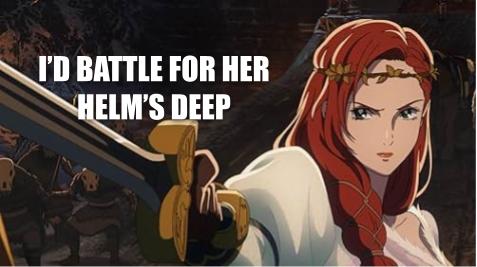
WotR is a decent tale, and I can see how it feels like a JRR Tolkien story. When condensed, it sounds like LotR, “Dude gets a ring, is told it’s dangerous and needs to be destroyed, makes some friends, loses some friends, one friend fights some wars, dude makes a bad friend, goes to bad place, realizes a fat friend was a good friend and bad friend was evil friend, destroys ring, other dude becomes king because he fights wars good.”
The overall story is meh. Very meh. The true charm is in the characters. It’s in Frodo’s relationship with Sam, Frodo’s relationship to Gollum, Aragorn’s relationship with Gimli and Legolas, Gimli’s relationship with Legolas, Gandalf’s relationship with everyone, Merry’s relationship with Pippin. It’s about friendship and love, and that level of granular detail is lost in the preceding paragraph.
When it comes to WotR, while the story is meh, the relationships are also quite meh. There’s some good stuff in there, in Hera’s relationship with her singing brother, or her relationship with her maid. There really isn’t much else going on. Helm and Hera are often at ends. Helm is a classic misogynist. The antagonist, Wulf, is an incel misogynist. There’s other people involved, but they’re pretty flat. Their interactions don’t hold much more weight than just exposition. There’s little emotion.
That’s poor.
Is this what neckbeard meant when he said the writing sucked?
But the callbacks? The attention to detail? The threads tying the scenes together? That’s good shit.
“‘That’s your plan?’ ‘I didn’t say it was a good one!’”
That’s ok.
The opening scene being instrumental to the victory?
That’s ok.
The final fight being a callback to the relationship between the two characters?
That’s fine.
In a holistic sense, all of this (and other details I’ve missed) is great. There’s a lot of this kind of thing. The writing is coherent. It’s connected. It’s intentional. It thematically and metaphorically relates. It’s pretty decent.
The Verdict
So all in all, I just defined what different elements of writing are and how they should be assessed and how they contribute to the overall enjoyment and quality of a movie. That’s fine and dandy.
But was the movie LotR: WofR any good?
Eh. It was ok. It’s a classic anime retelling a classic Tolkien tale, with poor pacing, decent dialogue, ok story, and decent writing. It’s not outstanding, but it’s also not dogshit.
That’s right, I said it. The “writing” was decent. All of it was just fine. Was neckbeard right? Was his friend correct? Who knows! The answer lies in my ultimate rating for this film:
YMMV
I saw LotR: WofR in cinemas because I wanted to buy one of those hammer popcorn buckets, but my theater hadn’t received any. I’m sure the movie will be available on Netflix or Amazon Prime at some point. If you like anime, or like Tolkien, it’s worth an idle watch, but the empty movie theater was quite justifiable.

 85scenes Reviews
Leave a comment