
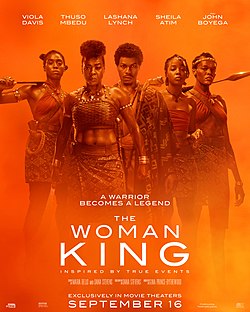
Two heroines, two stories, two hours, one movie
The Woman King is, in a word, gratuitous. It’s a decent enough film, exploring a unique story and a unique premise. The cinematography makes odd jabs at effort, the characters are refreshing and distinct, the action is decent, but the real failing is the bloated story and the ensuing issues in editing. All in all a decent historical action film that has two black, female protagonists. Worth the ticket stub just to indicate to Hollywood that these types of movies are ok to make.
The film follows two protagonists (for better or for worse). The first is Nawi, a new recruit to an elite women-only fighting force, The Agojie, in the kingdom of Dahomey. The titular heroine is General Nanisca, the hardened, weary leader of the Agojie. The supporting cast consists of two named, influential characters who are also Agojie, and another, unnamed recruit who serves as a foil/rival for Nawi as she goes through her training. The film follows Nawi’s journey as a new warrior, but also Nanisca’s efforts to protect her kingdom from a rival tribe of slavers, backed by Portuguese nobility who support them with weapons and supplies.
Fight the Power
The film is ambitious in its complexity of moving parts, but it’s not like this type of film hasn’t been made before. A comparison can be made to Young Adult Novel adaptations, like Hunger Games or Maze Runner, where a fiery, young protagonist must learn to become a fierce specialist of some kind, which then allows them to aid their mentors in overthrowing an oppressive system. The problem with both Maze Runner and The Woman King is that the complexity is, more often than not, too complicated for the short run time. It worked for Harry Potter because while the overarching idea of fighting an oppressive power is ever present, each novel, and movie, progresses slowly, confronting the protagonist, and the audience, with smaller, incremental challenges leading up to the big, final confrontation.
I’m not saying that all movies need sequels, or that movies with a lot of plotlines can’t happen, because they certainly can- it’s just really hard. The Woman King attempts this gargantuan task by introducing dual protagonists, and then being even more ambitious with a midfilm twist revealing deep emotional stakes between the two women. I don’t want to spoil this twist, but it’s also not all that crazy. It’s more of a ‘Shonda Rhimes/Grey’s Anatomy’ twist than an ‘M. Night Shyamalan/The Sixth Sense’ twist. As a result of having so many moving parts, the editor was tasked with cutting as much as possible to achieve a digestible runtime for the film. At many moments I felt that the film was running on for a little too long. Just on the car ride home we were able to discuss multiple ways to roll up and overlap emotional and action beats to save on runtime. Further, the cuts in the first half of the film were jarring in terms of tone, situation, story and even color. A couple of times the film snaps from a dark scene to a fuckin bright one, burning our eyeballs in a really poor transition.

In a gross culmination of these little failings, we get a very undeserving and underwhelming climax. Nawi does fuck all and is relegated to a damsel in distress for the most part, and Nanisca a short fight with her personal antagonist. We don’t get any true growth from either protagonist, and their flaws remain unresolved. The good guys win an overwhelming, gratuitous fight, where the evil slavers are killed, sexy eye candy man gets a beach scene, and Nanisca is named the Woman King.
Due to the unfortunate quick cuts and pacing of the first half of the movie, the explanation for this ascension and its political and cultural ramifications are glossed over in throwaway lines. Like, the very title of the movie is not explained because of editing and the need to cut down on a bloated runtime. To explain, the Dahomey believe that they are descendants of twin gods, one man and one woman. Recently, they have done away with a tradition of having a man king and a woman king to rule side by side (this part I’m guessing). The new king, played by John Boyega, seeks to reinstate this tradition and name someone as the Woman King. Nanisca has a secondary villain in one of Boyega’s many wives, who also plots to become the Woman Queen, in a bit of political drama. Again, this bit felt very ‘Shonda Rhimes/Grey’s Anatomy’-esque. So good guys fucking merc the bad guys, Nanisca becomes the Woman King, and Nawi…? At this point in the movie she’s already graduated from trainee to a full-fledged Agojie, so I don’t really know what the payoff for her was.
Man titties and T-Poses
To go back to the gratuitous thing, the film has a fuckton of ‘hero shots’. Moments where the heroes were framed against busy, dramatic or otherwise victorious environments to demonstrate just how important/cool the character was. It was fucking gratuitous how many times we got the fuckin T-pose action shot.
Speaking of gratuitous, there was a dude in the movie who was half Dahomey and half Portuguese, and this boy was HOT. That guy was straight sexy. Massive pecs, sharp cheekbones, long, curly hair, a really, really gratuitous near-nude scene where Nawi steals his clothes when he’s bathing. Then, it turns out that this guy is sweet, kind, sensitive and absolutely ethical and not racist at all. His narrative presence in the film is nonexistent and is only there as eyecandy. He is for The Woman King what Megan Fox is for Transformers.
I know that the film is important for Black representation, African culture, history and media and it was a big reason why I went in to see the film. If I can spend three hours watching swill like Terminator: Dark Fate, then I can absolutely make it a night to go see this. The film proves that it’s not difficult at all to make a movie that centers around women in an action movie- especially a good one.
6/10.
As a historical epic, there’s a good amount of fun information to be had here. While the film acknowledges that the Dahomey engaged, in some part, in the slave trade, a major theme of the film was to end the trade in the kingdom. In the film the king is on board with this idea, following a demonstration of the fiscal potential of palm oil. This king, King Ghezo was a real king, and unfortunately, he reinstated the slave trade after only halting it for five years. The following year, he was assassinated.
The Agojie, or also known as the Amazons, were one of the only all-female fighting forces in modern times, and remained an active military unit until 1904. The younger protagonist, Nawi, is loosely based on a real person, the last remaining Amazonian warrior, who died in 1979.
 85scenes Reviews