
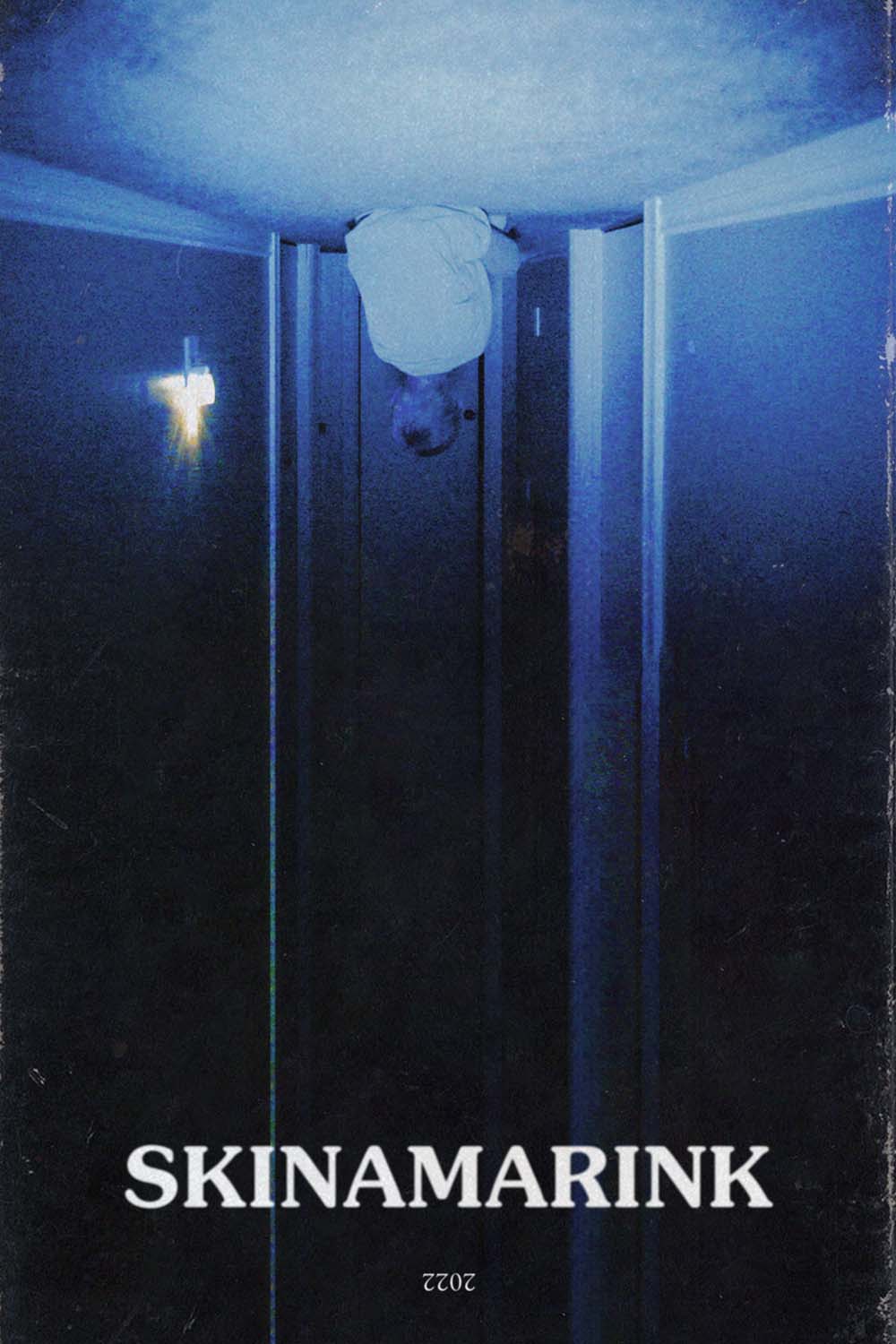
There’s a film making the rounds on reddit, and based on hearsay, TikTok, touted as one of the scariest films out there. Indeed, just watching the trailer for the film was deeply unsettling- and as a devious joke, I subjected all of my closest friends and family to sit through the preview. I was entranced.

I’d also seen the other recently popularized horror(esque) film M3GAN, and when viewed side by side, it’s easier to understand the impact of a film like Skinamarink.
The Marvel Problem in Horror Films
M3GAN unfolded with the usual telltale signs of a pop culture horror. Deep, relatable family trauma, character flaws, a supernatural entity that embodies the issue between the family members, shock and awe horror, hero shots as the entity commits evil, and a confrontation that culminates in the supernatural entity being shed as well as the rift in the family being healed in one act. It’s a formula that gripped audiences with Insidious and The Conjuring, and has continued through subpar deliveries like Annabelle, the lukewarm reception Malignant received, and then finally our favorite dancing child robot murderess. I didn’t know that M3GAN was a product of the forefather of these films, James Wan, until the credits rolled, and I released an audible “Aha. That makes sense.”

This horror film formula is an annoyance for those who spot the pattern, and no matter how much innovation Wan tries, be it body horror and campy action in Malignant or a robot in M3GAN, it’s not going to change the fact that these horror films are designed with a cookie cutter. It’s akin to Marvel’s overuse and misuse of the 3-act hero’s journey formula in every single one of their films. So when a film like Matt Reeves’ The Batman released, it gripped audiences by introducing a different story structure, one designed for an anti-hero, one that does not deliver a feel-good comeuppance the way shlock like Wakanda Forever climaxed. It’s an innovation that has likely spurred the changing landscape for all of DC’s films.
This is why Wan’s horror films do not truly feel satisfactory in their innovations- the core structure is unchanged- he’s only taken the liberty to change the coat of paint. M3GAN reskinned The Conjuring 2 to be sci-fi themed the way you’d flip between different skins on a video game character. Ignoring the bounds of studio guidelines, distributor brand ideals or even box office revenues, if we look at the idea of innovating the film itself, then we begin to realize why it’s important- and difficult– for films to find a new way of delivering an emotion such as horror.
Skinamarink is really Boring
Skinamarink is a two hour long film with an extremely analogue aesthetic, without a single person’s face being shown. The dialogue is sparse and difficult to hear and understand, and the focal points of each frame is not traditional. You can call it an experimental film due to the extreme deviances in the film from standard filmmaking. The assumptions of any film is that you’d at the very least see a person, see them interact, or for the camera to focus on a person or object, or maybe follow their action and motion. Skinamarink upends these foundational norms entirely, and it’s proven to be a difficult pill to swallow for most audiences.

I’m not going to do the pretentious thing and insult your intelligence by claiming that “yOu jUsT dOnT gEt iT bRo”. This film is tough to get through. What’s more is that this film is genuinely terrifying. It is a bone chilling hellfest of terror that covers existential fear, body horror and supernatural elements. Skinamarink is a scary fucking movie. If you watched it. Because while I purport to be a film snob, I legitimately had my phone out for nearly the entire runtime.
As much as I was using my phone as a way to deflect the fear of the film, it was also a welcome distraction due to the lack of stuff occurring on screen. There just isn’t anything that happens. Shot after shot, frame after frame, the film focuses on unmoving toys, darkened walls, unmoving halls. Things do not shift, but there is motion on our screen due to the light of cartoons the toddlers in the film are watching. A dull white and blue sheen perpetuates through most of the film’s runtime, illuminating the darkened house. The cinematography of the film, one of the greatest reasons that has caused dissatisfaction in its viewers, is paradoxically also the reason why this film is so unique and uniquely scary.
Because between the drawn out seconds, ticking away with nothingness, our eyes and minds fill the darkness with our own imaginations. Like a sensory deprivation tank of horror, the nothingness of the shots serves a purpose both for the horror and for the theme. You see, a film like Michael Bay’s Transformers is all movement, action, sound and information- too much for us to comprehend all of it. The noise is intended to create a sensation of excitement and action, tricking our minds into thinking that there’s so much going on that it must be cool. There is no breathing room for our eyes, ears or mind to fill any gaps because we’re far too exhausted trying to keep up. Skinamarink is the antithesis to this idea, and brings the action to a screeching halt. When the terror does occur, when the supernatural presents itself, it is often the only movement within the frame. A claw on a doorway for half a frame, the flickering of a reflection on an anthropomorphic toy, the twitch of an object that should not move on its own. The absence of movement lends itself to accentuate the rare movement that does occur, and it’s such an effective tool.
What’s more is that the film does not explain the supernatural horror, it does not attach itself to an obvious or spelled out family horror, it does not deliver closure. The demon isolates two toddlers in their own home by removing the adults, doors and windows. With no natural light and no help, the kids are left to fend off the supernatural with little to no understanding of their world. In the climax, the film delivers two sequential shots that seal the absolute terror of their hopeless situation before teasing us with the demon and then abruptly ending the film on an unanswered question. The idea that you will never know what has happened to you and that you will never be free of it is so absolutely terrifying in and of itself, and the film makes brilliant use of subverting our expectations to underscore that uncertainty. I have never in my life felt such fear and hopelessness due to a fucking number in a fucking movie. That’s how effectively this film’s structure and cinematography tie to the film’s story.
You don’t ever see the children’s faces. You never see the demon. You hardly see any movement. You never get an ending. The kids are never freed. The end.
Skinamarink is really Interesting
This is what innovation looks like. Skinamarink tears away all conventions and assumptions that transcend genres of film, and it combines its very core functions to embody fear itself. And as much as I’m shilling for the film, I will also admit that the film is deeply flawed, almost as a victim of its own effectiveness. The lack of movement was so jarring that, like I mentioned earlier, I was on my phone almost the entire time. The runtime is brutal, and I don’t blame people if they stop the film, walk out of the theater, or denounce it as a waste of time. I don’t blame people for being annoyed at the one or two jump scares. I don’t blame people for not feeling connected to the kids. To an extent, I understand the irritation when someone complains that the post-production filters that introduce the graininess felt like they came from a video editor like Adobe Premier or Da Vinci Resolve. I get it. I absolutely get why this film is so hard to watch. And to a greater extent, you wouldn’t be wrong if you thought that the film was just an overlong YouTube horror because that’s exactly what this movie is.
The film was created by a guy named Kyle Edward Ball, who has a YouTube channel called Bitesized Nightmares and there’s a 30 minute video on the channel called Heck and it’s essentially just test footage for Skinamarink. But that’s innovation. That’s success. A guy making videos for 20,000 subscribers kept making videos until he secured less than $20,000 in funding and then produced one of the most terrifying, unique films I’ve ever seen. It’s not perfect- it can’t be. But it is important and it is groundbreaking and it is exactly the kind of film that leads to positive changes to the genre in general. Just the way The Blaire Witch Project led change to more found-footage films and Iron Man led to the MCU, I believe that Skinamarink is going to lead to some very interesting changes to the horror genre. I hope.
8/10.
Don’t get me wrong, though, I enjoyed M3GAN and I do look forward to new Wan projects. But that doesn’t mean I don’t want something… more?
You can stream Skinamarink on Shudder with a free 7-day trial.






This does sound cool and like something I would check out- like those “slow train journeys” people love to watch. But I’m also curious about your comments on Michael Bay because, as a lover of Bayhem I’ve a long held theory that tracks with what you’ve just said. There is a lot going on in Bayhem… and it is fast and I’ve been in cinema with those who do find it a bit exhausting. But I kind of think there might be other kinds of people who can see it all going that fast.
LikeLike
I think that Bay is a ridiculously talented entertainer who has chosen to make films that are either the most offensive trash you’ve ever seen, or a masterclass in satire.
LikeLiked by 1 person
Or maybe a little from column A and a little from column B.
LikeLiked by 1 person