
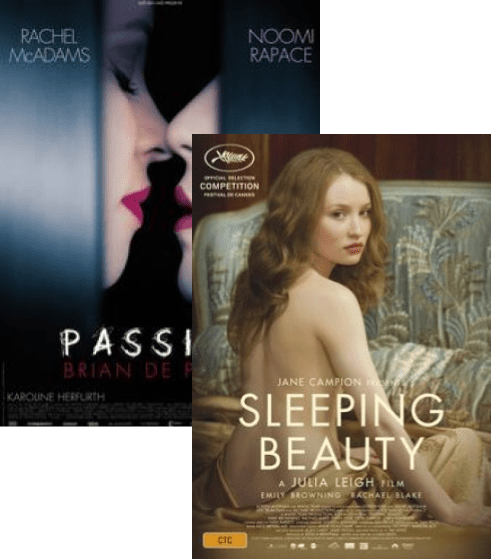
So I intended to write about the film Sleeping Beauty in a bubble, just on its own, but the nature of the movie is such that it became difficult to do so. Then, I watched Passion, and things flowed a bit easier. So here we go again, folks, we’re doing a dual film review about women!
Sex as Power
Both films, Sleeping Beauty and Passion, center around the idea of women’s sexuality being a source of their power, and one that they wield willingly, decentralized from men, to achieve their goals.
The former film, starring Emily Browning and directed by Julia Leigh, is about a young girl who uses her body as a commodity to earn money to move her life forward. As a result, she ends up accepting a job taking drugs that put her to sleep while rich, weird old men have their way with her body- the caveat being that she cannot be penetrated. It’s a slow, deliberate film. Its shots are long and lingering, each scene like sucking on maple syrup.
Browning bears boobs a bunch of times, but it’s not like you can whip it out and knock one out. The nakedness is pure vulnerability. Browning is asleep, limp, and lifeless. The scenes of nudity drip with disgust as the male actors do all they can to be as gross as possible. That said, Browning’s actions aren’t pushed under the rug, as the consequences of her actions- pushing as far as she can to commodify her body- leads to a harrowing, traumatizing experience.
The film Passion, directed by Brian de Palma and starring Rachel McAdams and Noomi Rapace, is a meandering, stylistic film that could be argued as sexist. The two leads, McAdams and Rapace, battle for power in their firm, taking turns to use sex to hurt the other, before murder under the guise of sex derails the otherwise boring corporate thriller. The movie culminates in two women battling for sexual victory before the film ends as a Shakespearian tragedy.
It’s always touchy when films try to use women wielding sex as an expression of their power and agency. Female sexuality is so rooted in the male gaze- as ironically ridiculed by my own blog- that any cinematic themes that approach this concept are automatically subject to intense scrutiny.
See, sex in the media has strong roots in the patriarchy. The James Bond films routinely used women with dumbass pun names as swappable sexual dolls for Bond to fuck between killing. So many films, like the first Rocky, Die Hard, and even the recent The Adam Project all use women as a prize for the male protagonist. This pattern isn’t a new concept. We can point to my favorite video clip as an example of using women, even when they’re capable and intelligent, as sexual subjects to gawk at. Oddly enough, the most disgusting example of this in the Transformers franchise isn’t my oft-referenced clip, but actually this one.
So if a film like Beauty or Passion wants to use women’s sexuality as a theme, the film needs to be squarely grounded in women and their motivations in something that isn’t men.
Beauty does a fantastic job of balancing this, in my view. While Browning does have an interesting relationship with a man, her motivation isn’t based on what he wants or needs, but what she wants and needs. Even the end, where her work leads to tragedy, the film spends its entire time and motivation centered around what Browning’s character is intending to do during that particular session. That worked for me. It helped that the director was a woman, who would acutely understand and place women and their autonomic desires at the forefront of a film, even when a man tries to put himself first.
I felt like Passion did a less effective job of putting women’s desires driving their need to use sex as a tool. The film’s initial conflict is cattiness. Two women, pitted against each other in a backstabbing, cheating nature. That’s… uh… a stereotype. But ok. We can explain that away as corporate office politics. Fine. Then Rapace’s character is caught sleeping with McAdam’s boyfriend, and their sex tape is used to laud over Rapace. Huh. Um. Ok… Then the murder happens because McAdams likes being blindfolded during sex, and Rapace uses that to sneak up on her to kill her. Huh. Interesting. The final twist involves the lesbian assistant knowing about Rapace’s plot the whole time, and is actually in lesbian love with the woman and uses her knowledge of Rapace’s murder to get her to lesbian sex her. Strike four, you’re out!
Sex in Film
Sex sells, right? And when it’s in a movie, it’s oftentimes used as a draw. The famous scene from Basic Instinct helped boost that film’s fame. All of Showgirls helped a terrible movie become more well known than just what crowds Elizabeth Berkley could draw in. Then when you have a movie that is about sex, the film needs to, ironically, have more going on.
That’s where we get the distinction between pornography and film. If a movie has sex in it as a byproduct, it’s still a video of prestige. But if a video is about sex, it needs to have prestige to still be considered a movie. I really had to shoehorn those words in those sentences to make it sound good. What I’m trying to say is that if a movie that is about sex has thematic or cinematographical lacks merit, then we’re left thinking the movie was just the director or writer trying to get the actress to get naked.
Movies aren’t just the images we see on screen, they’re a product of effort, and that effort is a result of someone helming a project. Someone has power. Someone is subject to their power. Harvey Weinstein knew that. The guy who made Megan is Missing knew that, too.
When a film intends to sell itself on sex, it also has to sell itself as a true, honorable movie. It has to have some merit to it outside of sex. The sex has to be central to the plot, the themes, the motivations. It cannot just happen for the sake of happening. If there are no consequences, then it’s just porn. Porn ends at the cumshot- a patriarchal beat- with no one paying heed as to whether or not the pizza was reheated, or if the plumbing got fixed. A movie has to answer those questions.
Both films, Beauty and Passion, go to extraordinary lengths to try to give their films enough artistic merit to justify their excessive use of sex. Beauty has a more successful time of creating compelling camerawork to underline the intent of each scene and action and filmmaking choice. Passion feels like a farce. The dutch angles, the blue tints, the dramatic lighting, the dream sequences all feel forced and manufactured. Their usage is loosely cohesive, and aren’t convincing as film techniques to justify the story and motivation errors I mentioned earlier. I just don’t yet believe that the movie wasn’t made so that the director could see his actresses naked.
Now, I’m not saying de Palma was a creep. I don’t know. But the movie wasn’t intentional enough, and thoughtful enough, to make me feel like the film respected that the women were using sex as a tool, rather than the director using sex as a selling point.
Sex in Reviews
It’s at this point that I have to justify my ratings for Sleeping Beauty and Passion.
Beauty is slow. It’s vague. The film ends abruptly, and explains nothing. There’s no answer to the question, “What are you doing step-bro?”. The rich guy kills himself, Browning wakes, screams, roll credits. We don’t know if she screamed in horror, regret, pain, or fear. We don’t know what she will do next. I know that that’s kind of the point of a film like this. That we get so much detail about her life from the opening to the ending, and that’s the point of this movie, but some folks would appreciate more plot. More cohesiveness and answers. That’s perfectly understandable.
The film Passion has a similarly abrupt ending when Rapace kills the lesbian assistant, but my aforementioned frustrations with the cinematography and boring first half dragged down the film. I couldn’t figure out why I should care. I couldn’t figure out why I should figure out the blue, tinted, nightmare weirdness. Is Rapace in jail? Did she kill McAdams? Who cares! The mystery felt akin to all of the Wild Things movies. It didn’t feel like a true thriller, it didn’t feel like some arthouse experimental film, it didn’t feel like high cinema. I don’t know what it was. But it wasn’t bad.

Pls laugh.
I could tell that de Palma had put in some thought and some effort into Passion. He was trying to muddle the relatively straightforward plot with some amount of confusion and mystery and opacity. He wanted to try to make the murder a mystery, he wanted to try to get us to wonder who’d done what and to whom. He used the dreams and the cinematography to try to do… something. And Rapace and McAdams also did throw their full weight behind their performances.
So both films are ok. They’re fine. They both had some intent, and some failings. They succeeded at some things, fell short at others. Some people may find either film a masterpiece. Some people will be appalled by either film. Some people would argue with me vehemently about Beauty being feminist, some people may think Passion was feminist enough. There’s some wiggle room for either film, but I think most people would agree that Beauty is closer to GOOD and Passion is closer to BAD, but both films fall squarely within
YMMV
I watched both films on Tubi, but as of writing this review, they’ll be expiring in a few days.
 85scenes Reviews
Leave a comment