

The Post-Covid Blockbuster Experience
So on December 16th, a Friday night, I pulled into my local theater. I purchased my ticket sitting in the car, tapped my phone on the bored teenager’s scanner to enter and huffed up the sticky carpeted stairs to the atrium. Cubist art depicting the golden days of the cinema adorn the walls, while mismatched pastel signs encouraged us to order snacks from our phones. I obliged, ordering popcorn and a hotdog, then sat on the bench while watching the haggard popcorn slingers struggle to clear their never-ending line. Looped ads and large cardboard 3-D cutouts emblazoned baby blue, advertising a blockbuster experience. More blue caricatures adorned popcorn tubs and soda buckets in the hands of families and children bustling by, excitedly swooshing and hollering as they streamed out of a nearby showing. A forlorn dad struggled to shepherd his child back to the Starcade, a cubby full of plastic and flashing lights and paper signs apologizing for the broken machines. The slingers missed my window to pick up my order, so I resigned myself to politely stand in line and asked them if I could get my shitty snacks. A pretty woman in a maroon polo filled my popcorn and handed me a comically large sized paper bag with a plastic sticker binding the top like a McDonald’s delivery. The line never ended.
Yes. I went to the opening night for Avatar: The Way of Water, and did not view the film. Instead, I clambered into a recliner in a theater populated with just four more people and watched a film called The Menu, a film that dared me to review it, and so I did. For the first time in a while, I felt that I had something I wanted to talk about. As the credits rolled, I kept thinking to myself, in a loop, ‘Did you like it?’ ‘I don’t know’, I responded.
There were three reasons why I wanted to see this film. Anya Taylor-Joy, Ralph Fiennes, and Nicholas Hoult. Taylor-Joy has enjoyed a spat of contemplative, artistic, somber works. She and her agent have handpicked roles that have built a brand that I’ve come to trust. The Witch, Split & Glass, my favorite The Northman, and the upcoming film Furiosa. She picks her projects well, and I know that I’ll enjoy them. She’s a talented actress, and she did not disappoint, despite all that held her back in this film.
Fiennes is an enigma. The last time I saw a film of his, King’s Man, I was thoroughly underwhelmed. Before that I remember his CGI snake guy in Voldemort, and that wasn’t bad. But he feels like he’s a stage actor picked up to be a film star, in the way of Hugh Jackman. Fiennes carries a gravitas that I feel invites people like me, but doesn’t deliver in the spades we expect. This film does not break that perception.
Finally, we have Nicholas Holt. His blockbuster credits begin with the new X-Man movies, but also include gems like Mad Max: Fury Road. He’s also got a Wikipedia page that reads like a guy who just does acting as a way to build his philanthropic platform. He’s a talented actor in his own right, and I look forward to any of his performances. Unfortunately, he’s also plagued by the fact that sometimes not even great actors can rectify portrayals of poor characters.
Also, John Leguizamo is in this, and he’s on the up and up.
A Palette of Genres
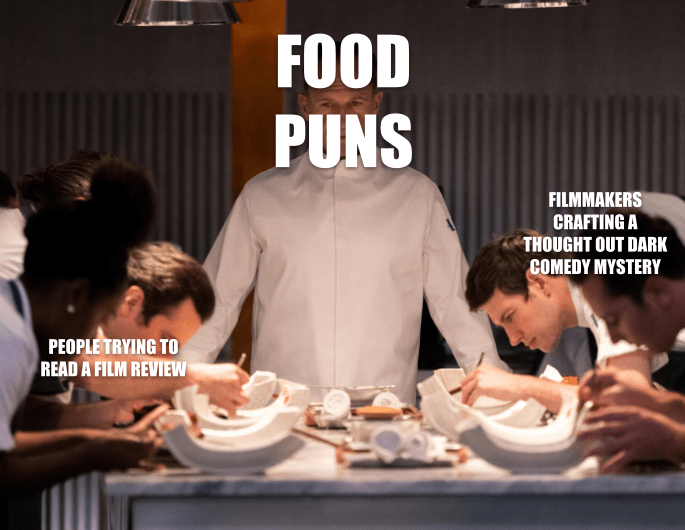
The trailers for The Menu indicate that the film will be a murder mystery of sorts, ala Death on the Nile, and the film opens as such. The gray color schemes of the modernist architecture juxtapositioned against the blues and browns of the island’s nature indicated a theme that would make use of these elements. As the film goes on, it begins defining its characters much the same way that an ensemble horror or mystery would. It defines its players in a positive or negative light using ego, sloth, greed, gluttony, apathy. The film is not subtle in defining flaws in its characters, painted as unforgivable. The billed A-listers in Taylor-Joy and Hoult, however, do not begin their presentation as such. Rather, their characterizations are nearly mundane, untainted by flaw, but also unredeemed by flavor.
Further, cracks in the production begin to form starting with the opening scene. The dialogue is muffled and hard to understand. It’s not that the soundtrack is too loud or that the actors are not enunciating- rather, it’s just the poor quality of the sound that makes their words indiscernible. The editing lacks the grace and poise that the script begs for. If your characters’ dialogues are plain, they indicate subtlety. If there is subtlety in your script, then the film requires breathing room. Not just in the framing of the characters in claustrophobic or spacious shots, but in the cuts and pacing itself. Let me think. Let me ponder. What did they say? What does it mean? What is the implication? What are the clues you’re leaving? If the film putters onto the next set piece without giving me the time nor the ability to digest what’s shown, then I’m going to feel a) frustrated and b) unengaged.
These two issues plague the movie, and I admit that I became numb to the feeling of frustration as I felt that the film became too cluttered for its own good.
Nevertheless, you’re aware that there’s something amiss in this film. Even if you were not exposed to any of the marketing for the film and went in blind, you’d still notice that there’s something wrong. The protagonist Margot, played by Taylor-Joy, is uncomfortable in the presence of an older man, who himself is uncomfortable in her presence. Margot winces at loud, sudden noises. Horns, claps, that sort of thing. The head chef, played by Fiennes, follows Margot into a bathroom and tells her that she should not be here. There is a silver door that she is not to enter in the dining hall. Then someone kills himself.
The nuances fade, and we’re presented with a series of overt, unforeshadowed character movements. Tyler, played by Hoult starts berating and belittling Margot. His adorable fascination with the culinary arts turns to pretentiousness without warning. An old man’s finger gets cut off. Shit like that.
The enmity between the chef and Margot begins fairly late in the film. While we’re asked to believe that their chef-diner enmity is a façade for a greater game of wills, we’re not allowed any subtext. The film presents its forces of will on a silver platter, dices them into bite-size pieces and then shoves them in our gullet at precisely the speed that we can handle. Moment after moment, disjointed events occur to the people sitting in the chef’s dining room. Some characters feel like they deserve their inevitable fate because they… visit prostitutes? Are finance bros? Selfish, has-been actors? Pretentious food critics? Enablers?
Hardly capital offenses.
The film stumbles through a moment of uncovering the chef’s secrets, spoils his own motivations, muddles together some weird mommy issues, and then, delivers the climax to us without any nuance or grace.
Look at this frame. The frame is gray, and the chef has his restaurant, but he looks mad. Look at how happy he looked here. He used to make burgers. This frame is brown and sits away from the other frames. Pay attention. Burger.
Then, a split 10 minutes later, B U R G E R C L I M A X.
An Artist Scorned
The climax of the film depicts a chef who’s smile cracks through his angry, murderous visage as he serves a simple burger to his enemy, sitting dissatisfied, bold and hungry in his dining room. The actual mechanic of how Margot escapes from the chef’s murder kitchen is actually quite clever, but there was little to no setup involved in this climax. There was nothing to be learned about Margot that would define what she did differently to escape from the horrors.
Yes, she’s a ‘working’ class ‘working’ girl. She tends to be more in tune with the chefs as humans, rather than as specimens to be viewed, or workers to be reviewed. That’s not a trait that needed refining. Her burger realization wasn’t one that was hinted at during one of the chef’s many weird speeches. It was literally a visual prop we saw not ten minutes ago in the movie. The chef’s own enmity with Margot wasn’t even an enmity, it was more an irritation that she had arrived here uninvited and unexpected. He tries to convince her to choose how to die, and she refuses to choose. Her clever ruse is… a weak point of characterization.
And this brings me full circle to my initial complaints about how I expected something special from a project picked by three actors with a penchant for picking good projects. The plot is… intriguing. However, the narrative is poorly constructed. The characters are not fleshed out beyond the obvious. Worse than that, the cinematography is severely handicapped because the film takes place mainly in a single room. However, the Director of Photography has tried to implement a handful of unique quirks and flairs to distinguish this film. Unfortunately, all of the lukewarm pieces cannot come to a satisfactory whole because ultimately, the direction of this film is flat, bland and completely unimaginative.
In moments of gravitas, of emotional weight, of narrative reveal, the direction fails to capture anything of note. It is unable to distinguish these moments as noteworthy or special, and continue plodding on from beat to beat, line to line. The film had so many empty shells of mystery crammed onto the plate that it became difficult to let the film sit and highlight scenes that were worthy of highlight.
The tragedy of the chef’s passion for his art was destroyed by the people in the dining room, but I don’t know exactly how sympathetic it made him. Each of his targets was comically evil, and lacked nearly any hints of redemption. Further, there seemed to be more than one innocent person caught in his crosshairs. A girl who went to a prestigious university and made it out without student debt deserved to die, as the butt of a joke. An older woman whose only role was to be shocked when it’s revealed that her husband cheated also dies, but it is not stated why she deserved to die.
The film The Menu holds a lot of potential for what could have been. A cast as strong as this, a concept as original as it was, I think that this film could have been a more powerful story, akin to Black Swan and Whiplash. These films all feature artisans so focused on their craft that they turn to insanity or irrationality in the face of obstacles they cannot overcome. I think that the film was hindered by its lack of focus in its marketing and in its own script. It just so turns out that The Menu is a dark comedy. There are many moments of grim, dark, deadpan humor that left me chuckling, but the four normies who couldn’t get a seat for Avatar just sat there in awkward silence. Unfortunately, we all expected something different than what we had ordered.
5/10.
I have a ridiculous crush on Anya Taylor-Joy. I want her to step on me. I want her to make fun of my complete obsession with films. I want her to… ahem. Yes, a very good movie. Indeed.
You can watch The Menu in theaters currently, but I’m sure it’ll end up on some streaming and renting services. It’s fine film to watch on a boring Tuesday night.
 85scenes Reviews