
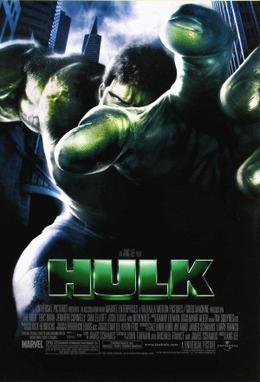
I have memories of gripping a Playstation 2 controller and firing up a Hulk video game, where I play I control the Hulk in third person, wreaking havoc on tanks, squishing soldiers and tossing boulders at helicopters. I remember being confused and annoyed by the ending, and I remember that insane fight where three hulk-dogs fight the Hulk. I remember being excited that the movie takes place in the San Francisco adjacent areas. I remember being confused by the weird mold zoom in sequences, and the fear as a result of the intensity of the sequences featuring the Hulk. I didn’t understand Hulk, but I did appreciate that it was… good? It wasn’t bad. And it still isn’t, really.
An Atypical Director, Pre-MCU
(and a major dumbass mistake on my part)
Hulk, not to be confused with The Incredible Hulk, is a 2003 film, starring Eric Bana, Jennifer *swoons* Connely and Sam Elliot, who also played the original Ghost Rider in the Nic Cage films (also a Marvel property). It’s weird, but Elliot feels like he aged to 80 sometime in midlife, and stopped aging for a solid 20 years. I absolutely loved him in Netflix’s The Ranch, where he plays a crankedy old rancher, but he’s really no different as General Ross in Hulk. I love Sam Elliot, despite his weird comments following The Power of the Dog.
I studied Spike Lee in one of my aforementioned film classes, more specifically his film Do the Right Thing, a film so ahead of its time, it actually predicted the BLM protests. He delves into conventions of social norms and agreements, juxtaposing capitalism’s role in how people are treated and perceived. It’s a wonderful, powerful and deep film about the habitants of one street in the intense, overwhelming heat of summer. It’s open to multiple meanings and interpretations, which is a cinephile’s wet dream. This guy was picked to direct a blockbuster superhero movie, hot on the heels of the first Spiderman. In 2003, Hulk opened alongside Finding Nemo and Austin Powers: The Spy Who Shagged Me. As of writing this review in 2022, those are not particularly impactful titles, but in reality, having a film slug it out against Michael Myers and Pixar is a really tall order.
Despite the ‘weirdness’ of Hulk, the film still topped out due to name brand recognition. Critical response was mixed, at the time, but has since warmed. This complicates things for me, who’s only just decided to talk about the movie, nearly nineteen years since its release. Like I mentioned, I was lukewarm towards the film as a kid. I didn’t dislike it, but I wasn’t particularly all that entranced by it either. As an adult, however, I spotted some notes of the film that were far, far ahead of its time- as is the norm with Spike Lee.
And it is about this time that I discovered that the film was made by Ang Lee, not Spike Lee. I am dumb.

Why people may not have liked Hulk (2003)
Hulk is fun, but it’s a tough watch because it mixes really serious themes of childhood abuse, trauma and its ramifications on adult relationships, and how a cycle of abuse can perpetuate even if the trauma is blocked out. But it also ends up asking us to have a high suspension of disbelief. Like, there’s a green man who breaks tanks, y’know? But then there’s also father figures whose feud transcends their duties to fatherhood, and how their abandonment of their children and subsequent weaponization of their offspring to help them achieve their goals is just more abuse. I never saw these deeper elements when I was watching the movie as a kid, even though I knew that there was a good reason why we had so much time spent with Bruce as a kid.
This is one of those movies where flashbacks aren’t… bad per se? I’m vocal about how I think flashbacks are a lazy storytelling device, and an unimaginative way for filmmakers and storytellers to introduce chekhov’s guns, clarify or establish motivations, or even inject exposition as an afterthought. In a film whose theme centers around childhood trauma and abuse, it only makes sense to keep drawing parallels or revealing more of a past event in order to show the progression of a man’s acceptance of his abuse.
Unfortunately, as a result of Bruce being the protagonist, Betty is relegated to a very traditional role of ‘emotional support female’. While there’s depth to Connelly’s character, in the form of her own strained relationship with her father, we don’t get much in terms of her motivation that’s outside of helping a man. Her stated goal is to help Bruce reveal more about his past and childhood before his adoption- something that the guy refuses to acknowledge. It is implied that this has driven a wedge in their relationship, even though Betty is shown to have revealed her own childhood trauma that was caused in the same place and time as Bruce’s. However, it is implied that her trauma was caused when her father abandoned her in an ice cream shop, and she was subsequently sexually abused by a stranger trusted to take care of her. As much as ‘woman is strong because of sexual abuse’ is an overdone trope, I think that it more or less is ok in this case. But again, aside from wanting to help Bruce, the woman serves no narrative purpose.
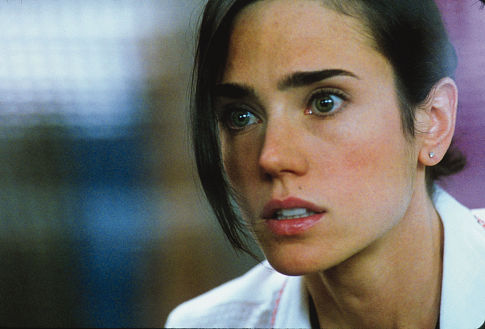
yeah, imma be horny on main, sue me
Now, another point where people may have lost faith in the movie is the way that ANG Lee, not Spike Lee, has chosen to integrate an amount of comic book panel-type editing. The picture-in-picture, multiple-angles-per-frame type of shots is new and innovative, evocative of the multiple frames and reactions per page that we get in comics. It’s not present in every shot or scene, so that it’s a gimick, but it’s used sparingly. I don’t spot a rhyme or reason for why and when, but I did notice that was a technique used only where it is the least intrusive and most effective. It’s not a bad technique, and I actually think that it’s very efficient and visually interesting. It allows us to see multiple peoples’ simultaneous reactions when they’re framed in a way that a traditional camera setup wouldn’t allow. Or it allows us to fastrack a movement sequence and provide a way for the audience to see how the film moves place to place in a hurry.
Then there’s the weird dream sequences as they focus in on the mold and spores and shit, but I don’t really get that. Maybe some sort of on-the-nose allegory for growth? Change? I don’t know. I would just ask Spike to be sure.

So is it any good?
7/10.
Good lord is Jennifer Connelly so goddamn beautiful. I really appreciate that the film didn’t sexualize her, and instead chose to overdose us with close ups. I’m a sucker for pretty eyes. *swoons*
 85scenes Reviews
Leave a comment