
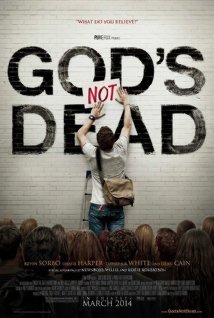
I know what this movie is about. It’s about the Christian god. It’s about Jesus and church and all that stuff. Imagine my surprise when I realized that the movie features a Muslim, burka-wearing woman who feels the need to listen to Christian scriptures in defiance of her middle-eastern dad? An atheist celebrity who ambushes religious celebrities who gets cancer? An atheist professor who feels personally attacked by a devoutly religious student? Here we go!
Religious Stakes
This film is focused on a religious, focused young man new to a college: Wheaton, Josh Wheaton. He says that a lot. Like he’s Bond, James Bond. He decides he cannot surrender to an atheist professor who wants his class to declare that ‘God is Dead’, or, in other words, that there was never a god.
Religious propaganda undertones aside, I can get behind the premise. It’s a protagonist with a goal misaligned from his antagonist. The protagonist experiences loss after loss- his girlfriend, his future, and more. But he’s emboldened by his supporters: his church reverend, random Chinese Communist Party classmates, and the parallel story of the atheist celebrity. It’s interesting. Again- you have to disregard the religious propaganda to see this is a real film. The main character deals with real issues, real risks, and real characters. It’s more than you’d get from most other schlocky films.
There’s a third story arc, of a woman with dementia, her loyal daughter, and her business-obsessed son, who is revealed to be the boyfriend of the atheist celebrity which is revealed at the 54th minute of a 1 hour 52 minute movie- let’s see where this goes. As an additional twist, the loyal, 20-something year old daughter is the wife of the atheist, 40-something year old insecure antagonist professor, played by Kevin Sorbo. “You were my hot, young girlfriend with a chic job,” is a line said after Sorbo, who dates the hot young atheist, finds out she has cancer.
Fishy Cinema
Those that ‘believe in god’ are considered works in progress, according to the film and the antagonists of the film. These same, religious, people are generous, forgiving, and the subjects of constant bullying. It paints the religious protagonists as sympathetic. It’s an effective technique. From a writing perspective, they’ve got a leg up, and they’re using it to its full extent.
As an aside, Tubi is slamming me with ads on this movie. And the targeted ads? I’m enjoying confusing Tubi’s algorithm. In addition to ads in Spanish, I’m now getting ads for fringe, for-profit colleges. There’s so many ads.

As for those folks who aren’t believers, the films gets to really punish them, too. The atheists are given cancer, breakups, and loneliness. The theists are given loving, caring, loyal wives, financial success, and (even if it’s for a short amount of time) hot, young girlfriends.
The camera work is interesting. For basic, shoulder-over shoulder scenes, they employ a relatively clever technique: shaking the camera. Not shaky cam. No, they just move the camera left and right, slowly and surely, at the same pace between cuts and zoom-ins. It’s a great way to stimulate movement for an otherwise still scene. After noticing it about an hour in, I realized that the camera moves frequently throughout the film. It’s never still. It fills the void of movement of the characters by moving the lens itself. It’s a technique that clever, inventive filmmakers would use. Well done!
At this point, I gotta acknowledge that the movie is meant to serve as a vehicle for religious sermons to counter scientific points with Biblical passages. Now, I can forgive that under the umbrella of ‘let’s blow past the religious propaganda’, but religion is the focus of the movie, right? The driving force of the film. So I have to admit- if the philosophical arguments are the pivotal points of this film, they’re never given the importance. They’re undercut with other plotlines and undeserving cuts. With 41 minutes left, let’s see what the climax looks like.
That said, in moments of violence and tension and action, the film utilizes the dutch angle effectively- if shortly.
The Grand Comedy
Ok so now let’s talk religious propaganda. I laughed out loud when the Muslim father beat and kicked out his daughter- my humor was not due to the abuse of women, but because the daughter loudly declared something along the lines of ‘Jesus is my savior and he died for my sins!’ right before getting slapped around. I mean. Lady. C’mon. Come on.

Plus the gratuitous bullying of religious people? I mean. No one behaves like that. A professor verbally, and, sometimes physically, accosting his students for their beliefs? That’s fucking illegal.
The CCP expatriate becoming estranged from his Chinese dad over his religious zeal? Lol. No. A pastor’s car not starting not one, not two, but three times? Just so that he can console an ex-Muslim Christian convert? Lord. That’s just… Floral. Absolutely decorative.
Religiously Honest Reviews
It’s worth noting at this random point, a point that I chose at random, and without editing or proofreading the rest of this post, that the critical reception for this film was overwhelmingly negative. Most people cited that the film painted colleges and universities as anti-religious.
As someone who went to three different colleges across eight years, let’s just be clear: colleges and professors are not anti-religious. Colleges and professors are too scared of offending the types of people who make, watch, and believe movies like God’s Not Dead to say or do anything remotely offensive to any religion. They just don’t. I honestly think that professors don’t care if anyone is religious.
But critically, I don’t agree with the other folks. I don’t think that this movie is ‘heavy-handed’ or “as subtle as a stack of Bibles falling on your head”- citation (because I don’t care to do a proper citation on this rinkidink two-bit movie review blog).
I knew what it was, coming into it, like I do with all Vin Diesel movies, or the Twilight movies, or even any MCU movie. It is what it is. Let’s look at it from the perspective of filmmaking, given that the focal point is that god is Jesus, or Iron Man, or Edward is a vampire, or that god is Vin Diesel’s penis. Right?
So that’s how I approached this movie. Given that, let’s approach the climactic sermon.
Climactic Big Bang
Like I promised, the judgement of this film falls upon its climax, and the protagonist Josh’s final of three lectures on religions against his atheist professor.
Look. I’m not a philosopher nor a lawyer. I’m not an expert in argument or debate. But I can tell that the climax, from a conflictive perspective, that Josh’s theist argument is based on an assumption that god exists, and his antagonist continues the argument on that basis. He allows himself to be cross-examined, rather than challenging the assumptions of Josh’s arguments. He allows himself to be emotionally moved and loses the logistical groundings of his argument, thus losing the total argument.

So. Yes. Emotionally and dramatically, the film moves the viewers, and the physical audience of the students of the class, into believing that a god exists. Like a sports movie when the underdog knocks out the heavyweight. And, from a dramatic perspective, that’s dope. A whole class stands up in support of the protagonist? Hellyeah. The liberal, atheist professor of a university is humiliated and defeated, so who cares about the basics of debate? This was awesome!

As an easy out for explaining why I didn’t really like the movie, I wish the music did a better job of underlining a momentous occasion. It’s… Look. When the good guys win, there’s a big musical crescendo. A real cinematic moment. I didn’t really, really get that. I sort of got it. But, y’know, there’s a ton of plot lines. The others played out, what with the theist celebrity ambusher and the reverend, and the Muslim convert. But, again, without their necessary musical magnitude. I wish, from a filmmaking and storywriting perspective, things had gotten the gravity they deserved.
So. Religious propaganda? Yes. Cinematically sound? Also yes. Worth a watch? Not really. God’s not Dead is pretty basic. Nothing incredible. It’s too pointed. It’s too focused on an intended audience. Just as someone who enjoys Gerard Butler action movies wouldn’t enjoy a romcom, I don’t think that a non-religious person would enjoy God’s not dead. Nothing in this film is so groundbreaking that you’d miss out on something unique if you didn’t watch it.
Also, turns out, the final debate wasn’t really the climax. So. Narratively, things really, really drag out. I’m not sure who the real protagonist is, nor who the main character is. Kevin Sorbo? The reverend? Wheatley, Josh Wheatley? Is it just Jesus? Who knows! God is willing to forgive you of your sins- all of them!
YMMV
Dude I’ve gotten more ads during God’s not Dead than I have for any other movie. That’s a sign. A religious sign. To consume. To participate in capitalism. USA USA USA.
 85scenes Reviews
Leave a comment